







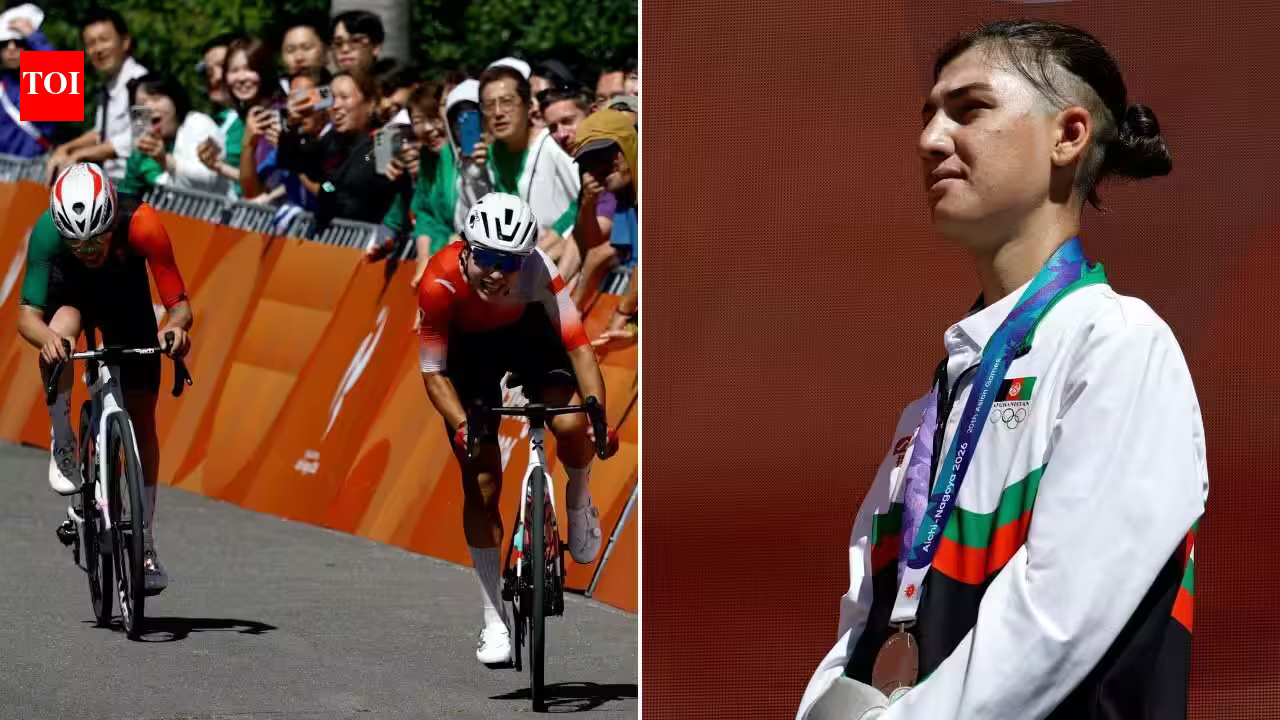
AICHI-NAGOYA — The podium at the Aichi-Nagoya 2026 Asian Games saw more than just a cyclist receiving a medal on Tuesday; it witnessed the triumph of a human spirit that refused to be silenced by stones, threats, or institutionalized oppression. Fariba Hashimi, the 23-year-old Afghan road cyclist now residing in Italy, surged across the finish line to capture a historic silver medal, an achievement that transcends the boundaries of sport and serves as a defiant beacon for millions of women living under the shadows of restriction.
The atmosphere in Nagoya was electric as the women’s road race concluded, but for Hashimi, the weight of the moment was far heavier than the carbon-fiber frame of her bike. As she stood on the podium, draped in the colors of her nation, the silver medal around her neck represented years of subterranean struggle—years spent in a country where her very presence on a bicycle was viewed as an act of rebellion.
A Journey Forged in Shadows
The path to the podium was anything but conventional. In her native Afghanistan, Hashimi’s early cycling career was defined by survival. As a teenager, she had to adopt extreme measures to follow her passion, frequently disguising herself as a man just to ride in public. Even then, the threats were omnipresent. She recalls, with haunting clarity, being pelted with stones while training, targeted by those who viewed a woman on a bike as a transgression against societal norms.
“I was born inside a country where the women who dream are getting attacked,” Hashimi said in an emotional post-race interview. “I’m really happy that I have fought against that.”
Her journey took a radical turn in 2021 when the Taliban returned to power. The subsequent erosion of women’s rights, which stripped away access to education, sport, and public life, forced Hashimi into exile. Alongside her sister, Yulduz, she fled Afghanistan, eventually finding a sanctuary in Italy with the vital support of former world champion Alessandra Cappellotto. This support system provided the training environment necessary to turn Hashimi’s raw, defiant talent into world-class performance.
The Symbolism of Resilience
The silver medal secured in Japan is being hailed as one of the most poignant moments of the Aichi-Nagoya Games. While the record books will note the race statistics, the true significance lies in the message it sends back to her homeland.
“They took away our freedom, they took away everything from us,” Hashimi remarked regarding the situation in Afghanistan. “This silver medal can show a lot of resilience from Afghan women, and I’m really happy.”
For Hashimi, the victory is not a solitary one. She spoke candidly about the support she feels—not just from the international cycling community, but from the women who remain in Afghanistan, hidden in the shadows but holding onto the same dreams she once fought to keep alive. “I’m not alone,” she stated. “I know that behind me, millions of women, from many countries, have the same dream and they are standing with me.”
Looking Toward Los Angeles
Hashimi’s ascent to the Asian Games podium is the natural progression of a career built on relentless perseverance. Having already represented Afghanistan on the global stage at the Paris Olympics two years ago, she has firmly established herself as a formidable force in the peloton.
However, she is not content with the silver medal in Japan. With the 2028 Los Angeles Olympics on the horizon, Hashimi is already mapping out her next challenge. Her career serves as a masterclass in persistence, transforming a young girl who once hid her identity behind loose clothing to train in fear into a professional athlete who is now an internationally recognized symbol of hope.
“I never want to give up,” Hashimi declared, already looking forward. “Hopefully, we can see what can happen again in Los Angeles.”
A Legacy in the Making
As the dust settles in Nagoya, the broader impact of Fariba Hashimi’s performance cannot be overstated. By competing openly and successfully, she has challenged the narrative that Afghan women have been erased from public life.
“I hope that the next generation will come here and represent their country without any fear,” she added.
Hashimi’s story has become a rallying cry for sports equality. In a world where athletes are often judged solely on their speed and tactical prowess, Hashimi serves as a reminder that some victories are won long before the starting pistol fires. Her silver medal is a testament to the fact that while policies can suppress rights, they cannot extinguish the innate human desire for freedom—and for some, that freedom starts with two wheels and a road that leads away from fear toward a global stage.
As she departs Japan, Hashimi leaves behind a legacy of immense bravery, carrying with her the hopes of those who are currently unable to speak, yet are cheering for her from the other side of the world. The road to Los Angeles is long, but if history is any indication, Fariba Hashimi is prepared for every turn.
Disclaimer: This content is auto-generated for informational purposes only.
Source: Read Original News