









Solving Real-World Problems with AI
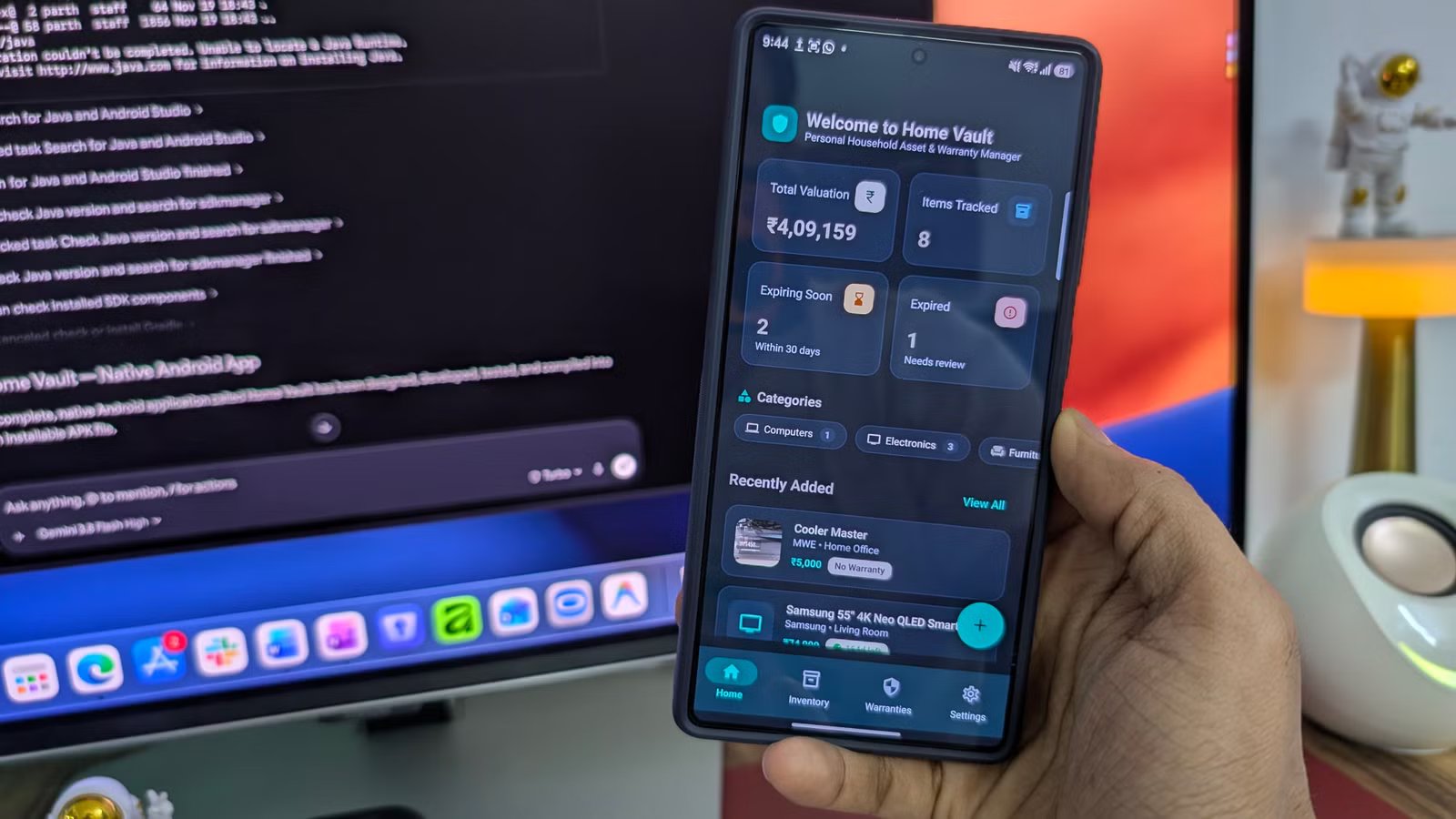
Modern artificial intelligence has moved beyond simple text generation or basic code snippets. As someone who has frequently experimented with AI coding tools, I often found that my previous creations—websites, dashboards, or temporary apps—ended up abandoned in digital storage. However, I recently challenged myself to build a utility that serves a genuine, daily function for my household. The goal was to create “Home Vault,” a centralized inventory system designed to track assets, manage warranty information, and organize service history.
To accomplish this, I utilized Gemini within the Google Antigravity environment. Unlike generic web-based wrappers, my objective was to create a functional, native Android application. By focusing on practical utility—such as tracking the value of expensive electronics and keeping digital copies of invoices—I was able to push the boundaries of what an AI-generated application can achieve.
Designing the Specification
A successful application relies on clear requirements. My prompt for Gemini was highly specific, dictating not just the functionality, but the architectural framework. I requested a native Android application built using Kotlin and the Jetpack Compose toolkit, adhering strictly to Material 3 design principles.
Key features integrated into this request included a dashboard that would display the total value of household inventory, categorized lists for appliances and furniture, and a notification system for upcoming warranty expirations. I also required the ability to attach media, such as photos of products and PDF copies of invoices. To ensure the app was usable by my family, I included requirements for offline functionality, a dark mode toggle, and a local backup-and-restore system. Most importantly, I instructed the AI to provide a compiled APK file, bypassing the need for a formal Play Store submission.
The Build Process and Technical Execution
Upon submitting the prompt, the iteration process with Gemini 3.8 was notably efficient, requiring approximately 30 minutes to generate the core codebase. The result was not a fragile prototype, but a stable application that integrated seamlessly with the Android OS. The Material You design language was applied throughout, featuring fluid animations, consistent iconography, and a layout that felt intuitive.
The technical impact of this approach is significant. Because the application was written in native Kotlin, it achieved a level of performance and battery efficiency that cross-platform web apps often struggle to match. The integration of Jetpack Compose allowed for a declarative UI, which makes future modifications to the app’s structure or features much simpler to implement. Testing the APK on a modern device, such as the Samsung Galaxy S25 Ultra, revealed a responsive, robust application that successfully fulfilled every requirement in the initial prompt.
Functionality Over Mere Prototyping
The true measure of Home Vault lies in its usability. By creating a dedicated section for warranty tracking, the app transformed from a static list into an active household management tool. The logic handles dates automatically, alerting users when a warranty period is nearing its end. By allowing for the attachment of PDF invoices directly within the product entry, I eliminated the common frustration of searching through email archives or cloud drives during a repair or insurance claim.
Because the app is a local, native solution, it ensures data privacy. My family members were able to install the APK and populate the inventory without the need for an external cloud subscription or a constant internet connection. Watching non-technical users interact with the interface—navigating the categories and uploading receipts—confirmed that the AI had successfully interpreted the usability requirements as effectively as it had the technical ones.
Reflections on AI-Driven Development
While Home Vault works perfectly for my family, it is important to distinguish between an experiment and a commercial product. I have no plans to release Home Vault on the Google Play Store. Developing software for a mass audience requires rigorous security audits, accessibility compliance, and ongoing maintenance that extends far beyond the capabilities of a single-session AI prompt.
This experiment was designed to measure the current capabilities of large language models in professional-grade software engineering. It demonstrated that we have reached a point where AI can act as a force multiplier for individual developers. Rather than struggling with boilerplate code or environment setup, I could focus on the user experience and the specific logic required to make the app useful for my home. As models evolve, such as the upcoming iterations of Gemini 4, the complexity of the applications we can build with these tools will only continue to increase, effectively lowering the barrier to entry for custom, high-quality software.
Disclaimer: This content is auto-generated for informational purposes only.
Source: Read Original News