








Fragile Forests: Experts Warn of Widespread Tree Mortality as El Niño Threatens Stressed Landscapes
Experts are raising the alarm that the convergence of a record-breaking summer and a powerful impending El Niño could lead to mass tree mortality across England. Having already suffered through a season of punishing heat and severe drought, the nation’s trees are now facing a secondary threat: high winds.
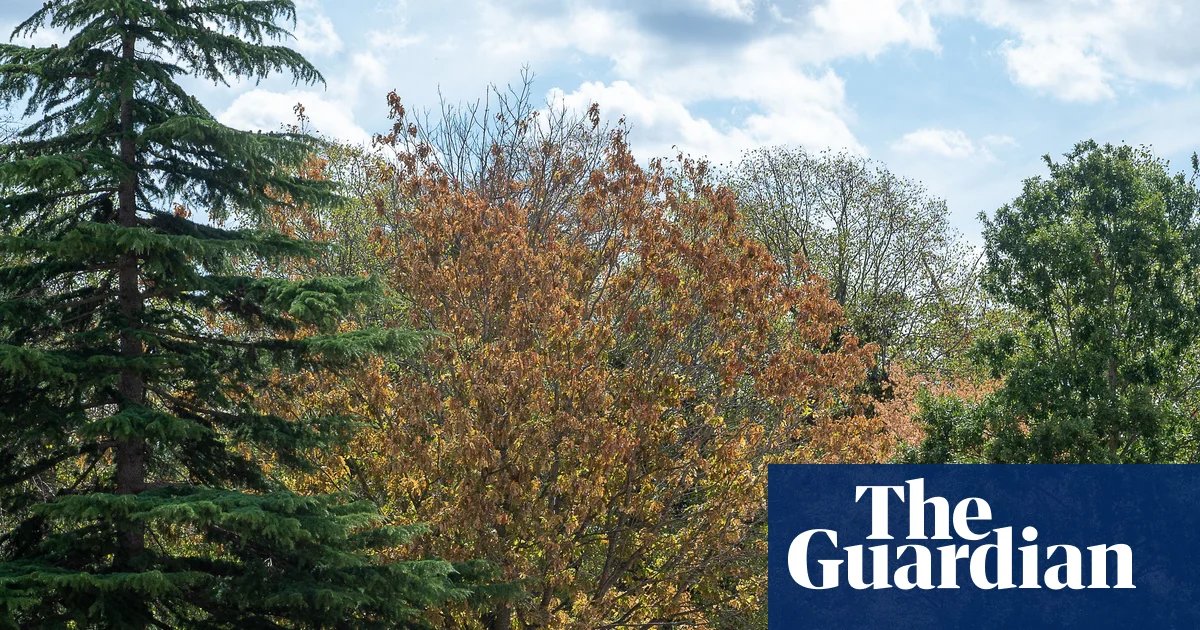
The European landscape, long defined by its lush, green canopy, has been transformed by a series of relentless heatwaves. Many trees, visibly wilting and shedding leaves in an “early autumn” response to preserve moisture, have been forced into a survival mode that has left them brittle and physically compromised.
Kevin Martin, head of tree collections at the Royal Botanic Gardens, Kew, explains that the trees’ inability to grow naturally under these conditions has stripped them of their usual flexibility.
“If we see the extreme winds that are predicted this year because of El Niño, we’re going to see potentially large impacts on trees,” Martin said. “We could then start to see some trees actually fail at the root plate. I’m really worried about this autumn.”
A Perfect Storm of Stress
The UK’s Met Office has warned that the current El Niño event—a natural phenomenon amplified by global heating—could be the strongest in more than a century. Forecasters anticipate a shift toward increased rainfall and turbulent storms, a combination that could prove fatal for weakened root systems. When parched, unstable soil is suddenly saturated by heavy rain, the structural integrity of a tree is severely undermined, making it highly susceptible to being toppled by high winds.
The devastation is not limited to younger saplings; England’s majestic, centuries-old oaks are showing clear signs of decline. Martin notes that the 2026 season has been uniquely destructive, beginning with an unprecedented May heatwave that saw temperatures hit 35C.
“The whole growing season this year has been under stress; I don’t think we’ve ever experienced environmental impact like this before,” he added.
A Long-Term Ecological Threat
While individual trees can often recover from a single year of environmental shock, the growing frequency of these events is a cause for deep concern. Simon Richmond, a technical officer at the Arboricultural Association, warned that the real danger lies in the shift from one-off weather anomalies to a sustained, climate-driven pattern of extreme stress.
Marcus Lindner, a principal scientist at the European Forest Institute, agrees, noting that even historically drought-tolerant species have a breaking point. “Species that are normally drought-tolerant are adapted to a certain level of drought stress, but if we have continuous and repeated drought, these trees will at some point not be comfortable with that any more,” Lindner explained.
Preparing for the Aftermath
At Kew Gardens, the outlook is grim. Having lost over 400 trees following the 2022 heatwave, management anticipates that the 2026 death toll will be significantly higher. Martin believes that many trees that narrowly survived the previous crises have simply run out of energy to survive this latest onslaught.
The full scale of the ecological damage may not be immediately visible, however. Arborists note that it can take two to three years for the final impact of these heat-stress events to manifest, suggesting that the “early autumn” many are seeing today may be the first warning sign of a landscape that is fundamentally changing.
As certain species—such as the silver birch and common beech—face the possibility of being wiped out from regions where they have stood for generations, the urgency of addressing the broader climate crisis has never been more apparent.