








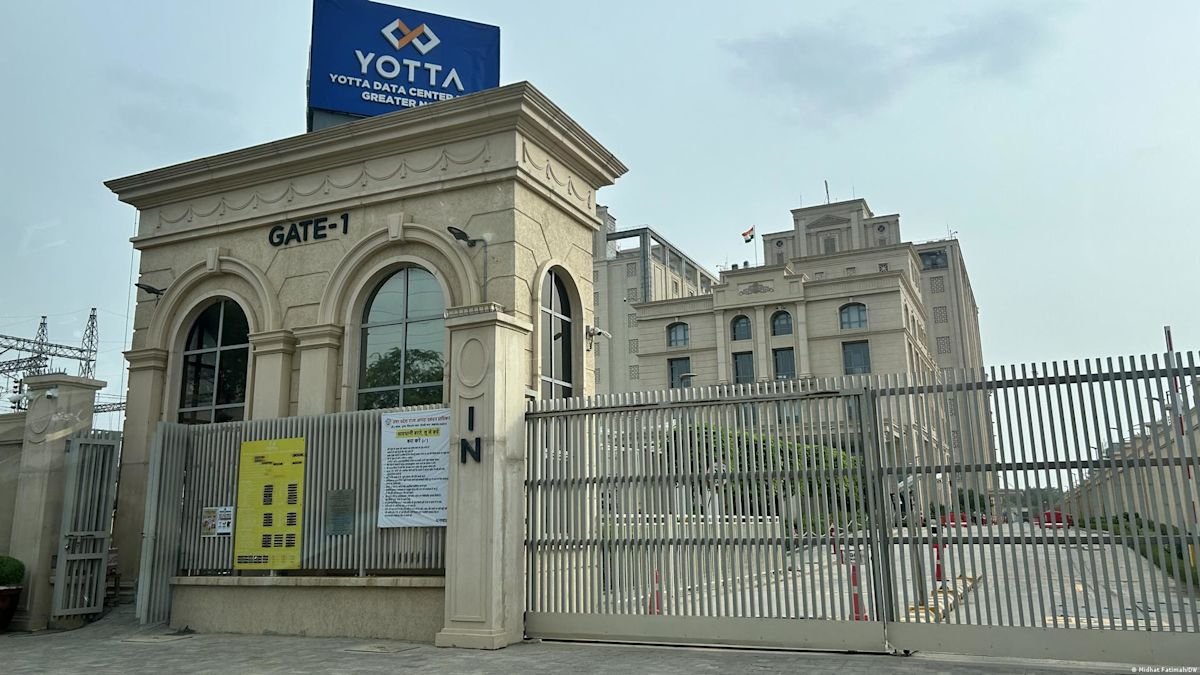
Ghaziabad, India – Residents of Khora, a densely populated area in Ghaziabad just outside New Delhi, are grappling with a severe and long-standing water crisis, exacerbated by the proliferation of new data centers in the region. These facilities, crucial for the burgeoning AI infrastructure, demand immense quantities of water for cooling, intensifying the strain on already scarce resources.
Deepak Joshi, president of the Khora Residents’ Association, stated that residents have been fighting for a reliable water supply for a decade with no resolution. "We are dependent on groundwater. In some parts, one has to dig 1,000-1,200 feet (305-366 meters) to extract water," Joshi told DW. India is rapidly positioning itself as a data center hub, but this ambition comes at a cost, particularly in water-stressed regions like Khora.
For carpenter Naeemuddin Saifi, a 35-year resident of Khora, obtaining water is a monthly financial burden. He, like many others, relies on a shared borewell connection, paying between 1,000-1,200 rupees ($10.5-$12.5, €9.1-€10.9) every month. "I cannot afford it alone," Saifi remarked. Joshi highlighted that a single borewell costs approximately half a million rupees, or about $5,250, a sum unaffordable for many families. Even with a borewell, the supply is precarious, with water levels prone to dropping unexpectedly. The severity of the situation has driven many families to relocate, according to Joshi.
A recent report by World Resources Institute (WRI) India revealed that over half of India’s data centers are located in water-stressed regions. Ghaziabad is a prime example, where groundwater extraction significantly exceeds sustainable levels. The Central Ground Water Board reported that in 2024-2025, water extraction was around 272% of the recommended annual extractable groundwater resources of 2,714 hectare meters.
Ranjana Ray Chaudhuri, head of the Department of Natural and Applied Sciences at TERI University, explained that while Ghaziabad and Noida were initially marketed for their abundant water resources, rapid urbanization has altered this dynamic. The region now supports numerous data centers requiring substantial cooling, which in turn expels heat that can affect the local microclimate, potentially increasing demand for air conditioning in surrounding areas. This creates a cycle of increased water use, not only directly by data centers but also indirectly by the surrounding communities. However, Chaudhuri noted that comprehensive data to fully assess the local impact of large data centers is still lacking.
Despite the dire situation, an anticipated project to reroute Ganges water to Khora was officially canceled in 2025, with authorities promising an alternative solution that residents, according to Joshi, have yet to hear about. Meanwhile, the AdaniConnex data center, a joint venture between India’s Adani Group and EdgeConneX, operates just minutes from Khora. AdaniConnex did not respond to DW’s inquiries about its water consumption. This facility is one of over 20 in Noida, an industrial city bordering Ghaziabad. The Uttar Pradesh 2026 Data Center Policy Draft further pledges "uninterrupted 24×7" water supply to data centers.
Prateek Aggarwal, a senior representative from the Council on Energy, Environment and Water (CEEW), a prominent non-profit research institution, emphasized the high water stress in the Noida region due to rapid urban growth and reliance on groundwater. He added that there are no official estimates for data center water consumption across the National Capital Region.
India’s total data center capacity has quadrupled since 2020, reaching approximately 1,500 megawatts in 2025 from 375 megawatts, according to the Ministry of Electronics and Information Technology. With 305 data centers operating across India, they consumed around 150 million tons of water last year, a figure projected to double by 2030.
Beyond the sheer volume of water consumed, concerns also arise from the lack of transparency and regulation. Gayatri Naik, co-director of the Center for Environmental Law, Education, Research and Advocacy at the National Law School of India University, described India’s regulatory approach as fragmented. While commercial entities need a no-objection certificate for groundwater extraction specifying limits, they are not typically required to publish their actual monthly or annual consumption figures.
Naik contrasted this with European policies, where the EU mandates data centers to disclose their water consumption and facilities with an IT power capacity of at least 500 kW must report key sustainability data to a European database. Aggarwal echoed the call for mandatory disclosure, advocating for annual reporting on energy, water, and carbon use, including water sources and recycling rates. He also urged for phased efficiency standards for water and power, and for decision-makers to consider water availability alongside land and electricity infrastructure when approving new data centers. "The real strain in a place like National Capital Region comes from many facilities sharing one aquifer, not any single project," Aggarwal stated.
Ultimately, Naik concluded, the situation raises fundamental questions about water allocation during scarcity. "How will you bring a balance between this water that is required for drinking as well as the water demands by these companies who are extracting the water from a water scarce area?" she questioned, warning of potential "social and distributive injustice."