





Recently, Newman House, the central Catholic Chaplaincy for university students in Westminster Diocese, hosted its annual ecumenical and interfaith lunch and meeting to which were invited colleagues from around the Chaplaincies of the various London universities. Since 2023 this has become a fixed part of the Newman House programme, after successful previous events involving speakers Benedictine abbot Dom Christopher Jamison, the ITV News journalist Julie Etchingham, and the ‘Word on Fire’ UK director, Brenden Thompson.
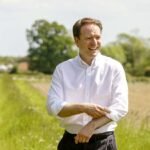
This year we welcomed some 17 chaplains from across London’s universities to hear the renowned Catholic academic, Prof. Carmody Grey, professor of Integral Ecology at the Laudato Si’ Institute within Radboud University in Holland, and currently a visiting professor at the LSE in London. Her background at Oxford and Durham Universities and other academic institutions has led her to specialize in those areas of theology that the papacy of Pope Francis drew renewed attention to, namely the ‘Care of our Common Home.’ Prof. Grey refers to this as ‘Integral Ecology’ and sees this term as a wonderful Catholic-theological framework with which to address many contemporary issues in the world.
She began her address situating us in the ‘polycrisis’-ridden global situation of 2026. Her starting point in introducing Integral Ecology is to propose that “we need the ability to act without trying to respond to everything at once, which we can’t do, but also without shutting out or denying the complexity or inter-relatedness of our problems.” She sees that Integral Ecology, located within the wider orbit of Catholic Social Teaching, is able to take an integrated, holistic approach to politics, economics, nature, climate etc.: “it expresses this sense that we need to put things back together again, we need to see things as parts of a whole and of that whole as having a certain sense or meaning; and if we do not, we cannot act.”
Her unpacking for us of the Catholic vision of Integral Ecology drew strongly on Pope Francis’s work in Laudato Si’ and Fratelli Tutti, and allowed us the hope that humanity can find “a counterpoint to our dominant paradigm, … ‘the technocratic paradigm’.” She summed up her theological approach in this way:
“I would say this is the fundamental spiritual discipline of Integral Ecology: a contemplative paradigm in which we dispose ourselves to pay deep attention to the world, the discipline of wonder and gratitude and praise.”
To find out more about the diocese’s provision for university students in London & Herts, including the ministry on campuses, and the 66-strong residential community of students at Newman House, visit: www.universitycatholic.net