







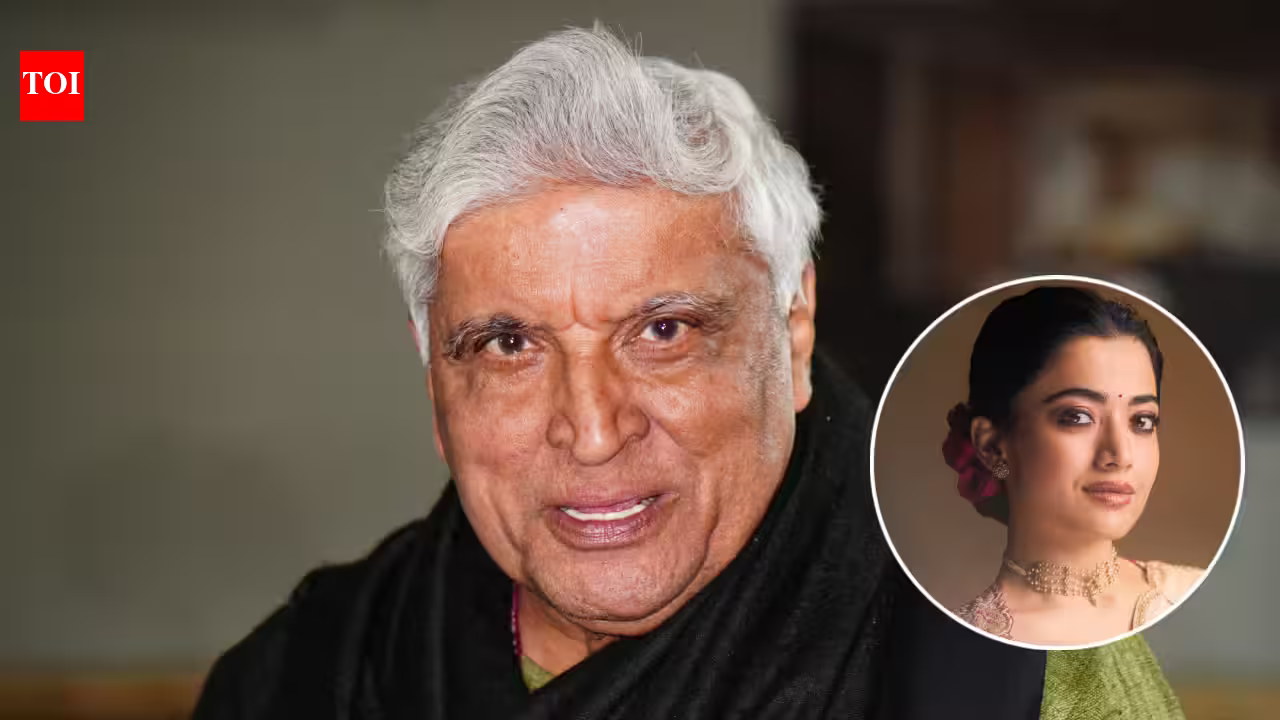
In the fast-paced, often unforgiving theater of social media, even an industry titan like Javed Akhtar isn’t immune to the “correction culture” that defines modern discourse. The veteran lyricist and screenwriter found himself at the center of a digital firestorm this week after attempting to defend actress Rashmika Mandanna against trolls, only to stumble over the very regional identity he was trying to protect.
The incident serves as a poignant reminder of the nuances surrounding India’s linguistic and cultural landscape, and how even those with the most articulate pens can occasionally lose their footing when navigating the complex tapestry of regional representation.
The Defense That Triggered a Debate
It all began when Javed Akhtar took to X (formerly Twitter) to call out the relentless trolling directed at Rashmika Mandanna. The “National Crush,” who has rapidly transitioned from Kannada and Telugu cinema to pan-India stardom, recently found herself in the crosshairs of netizens criticizing her Hindi accent following an appearance on Koffee With Karan Season 9.
Akhtar, never one to shy away from social commentary, came out swinging. He urged those mocking Mandanna’s pronunciation to test their own mettle with Tamil, a language he lauded as the oldest spoken language in the world. “Those who have any problem with the pronunciation of Tamil actor Rashmika should be given a few lines of Tamil… and let’s see how well they pronounce Tamil,” he wrote. He went on to label the criticism as a manifestation of “fake and baseless linguistic superiority,” arguing that such pedantry has no place in a diverse nation.
While his heart was clearly in the right place—defending an artist against regional bias—his premise hit a snag almost immediately. By explicitly labeling Mandanna a “Tamil actor,” Akhtar triggered a wave of corrective responses that shifted the conversation from the toxicity of the trolling to the inaccuracy of his geography.
The Pitfalls of “South Indian” Generalization
The backlash was swift and characteristically blunt. The internet, acting as a collective fact-checker, descended upon the comment section to inform the veteran writer that he had committed the very sin he was railing against: the homogenization of South Indian identity.
“She is from Karnataka and works predominantly in Telugu,” wrote one user, setting the tone for the correction. Others chimed in with variations of the same correction, pointing out that Mandanna is, first and foremost, a Kannadiga. Some even took the opportunity to call out Bollywood’s long-standing tendency to treat the five states of South India as a monolith.
One particularly pointed critique noted, “Writers like you in Bollywood created stereotypes about South Indians, Sikhs, Marathis, Bengalis, and every ethnicity in this country. So please don’t try to educate us about Tamil.” It was a stinging rebuke that highlighted a deeper frustration—the feeling that, despite evolving cinema, the Hindi film industry still struggles to distinguish between the distinct cultures, languages, and identities of the South.
Accountability: The “I Stand Corrected” Moment
In an era where public figures often double down, delete posts, or go silent when challenged, Akhtar chose a refreshingly direct path. Upon realizing the inaccuracy in his post, he didn’t attempt to spin the narrative or ignore the flood of corrections.
He simply replied to the discourse with a succinct, “I stand corrected.”
This brief acknowledgment acted as a de-escalation, allowing the conversation to pivot slightly. While some continued to voice their annoyance at the initial error, many others appreciated the humility of a man of his stature admitting to a mistake. It underscored a fundamental truth: even the most learned can succumb to the “South Indian” catch-all trap, proving just how much work remains in breaking down the barriers of regional ignorance within the mainstream Indian media landscape.
The Core Issue: Accent Shaming
Stripping away the geography lesson, the real issue at the heart of this storm remains the ongoing obsession with regional accents. Rashmika Mandanna, who has built a massive fanbase across linguistic borders, has been subjected to persistent scrutiny regarding how she speaks Hindi.
When addressing the backlash, Mandanna has been vocal about her frustration, questioning why her South Indian roots are treated as a hurdle rather than an identity. For many, the criticism isn’t about clarity; it’s about a performative intolerance for anything that doesn’t conform to a standard, homogenized “Delhi-Mumbai” accent.
Akhtar’s core argument—that demanding linguistic perfection is a form of elitism—remains valid. India is a country where code-switching is a necessity, not an option. Expecting actors to shed their phonetic identity when moving between industries is not just unreasonable; it is an erasure of the very diversity that gives Indian cinema its global flavor.
Where Does the Industry Go From Here?
This incident is more than just a funny mix-up or a moment of internet-fueled outrage. It highlights the shifting power dynamics in the Indian film industry. As “Pan-India” films become the norm, the wall between the North and South is crumbling, but the cultural education of those in the Hindi heartland has not kept pace with the box office success of these collaborations.
Javed Akhtar, a man who has written some of the most iconic lines in cinema history, inadvertently reminded us that even he is a student of this changing landscape. His willingness to acknowledge the mistake is a lesson in itself. As for the audience, perhaps this serves as a gentle reminder that as much as we value the stars who unite us across state lines, we must also respect the unique cultures that make them who they are.
Whether it’s a Telugu, Tamil, Kannada, or Malayalam star, the merit should lie in the performance—not the accent, and certainly not in which state the audience thinks they belong to. Rashmika Mandanna continues her rise, and if nothing else, this week proved that the internet is always watching, always correcting, and, occasionally, willing to accept an apology.
Disclaimer: This content is auto-generated for informational purposes only.
Source: Read Original News