







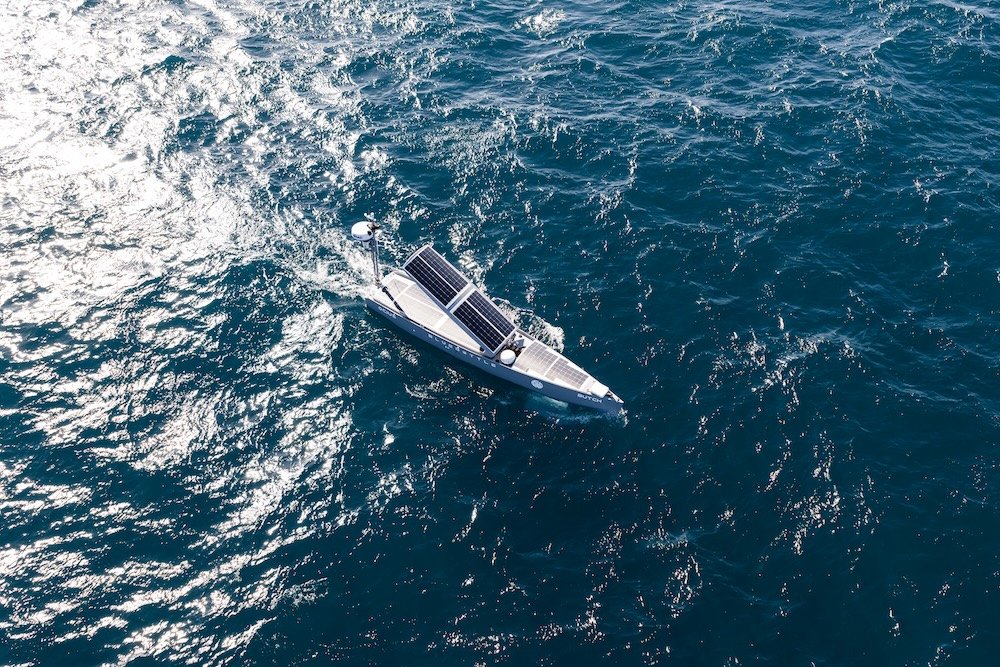
Ocius Technology has officially debuted its new “Bluebottle Hybrid” uncrewed surface vessel (USV) on the global stage, with two of the diesel-hybrid units currently undergoing rigorous testing during the U.S. Navy-led Maritime Big Play Pacific exercise. Running throughout October, this event marks the first time the hybrid variant of the renowned Bluebottle platform has been integrated into a multinational naval exercise, signaling a significant shift in how autonomous systems are being deployed to monitor undersea domains.
Enhancing Capabilities for AUKUS Pillar II
The Maritime Big Play series serves as a critical experimentation hub for the AUKUS Pillar II security partnership. By bringing together the United Kingdom, the United States, and Australia, the initiative aims to rapidly accelerate the operational maturity of uncrewed maritime systems. For Ocius, this exercise provides an ideal proving ground to test the hybrid USVs in realistic scenarios, including high-stakes anti-submarine warfare (ASW), maritime strikes, and complex seabed operations.
By integrating these vessels into the AUKUS framework, the partners are not just testing hardware; they are leveraging advanced software ecosystems. The Bluebottle Hybrids are equipped with ThayerMahan’s Outpost® acoustic intelligence payloads, managed by TransparenSea® processing software. This combination allows the USVs to detect and track undersea threats with a high degree of precision, effectively functioning as a force multiplier for traditional naval assets.
A Hybrid Approach to Persistent Surveillance
While the original Bluebottle platform is celebrated for its renewable-powered persistence—relying on solar, wind, and wave energy—the new hybrid variant introduces a diesel-powered generator. This design choice is a direct response to the operational limitations of purely renewable craft. In high-latitude regions or during long-endurance missions in low-light, winter conditions, solar-only systems often struggle to meet the power demands of advanced sensory arrays.
The hybrid architecture ensures that the vessel can maintain its mission profile regardless of atmospheric conditions. As Ocius CEO Robert Dane noted, the increased power capacity allows for the deployment of more sophisticated, high-energy payloads that would otherwise drain a standard battery bank too quickly. This evolution mirrors a broader trend in the tech industry: the move away from “all-or-nothing” green power solutions in favor of resilient, adaptable, and energy-dense systems capable of functioning in any environment.
Integration, AI, and Future Defense Tech
The integration of these vessels into the US Navy’s operational theatre highlights how far AI-driven autonomy has come in the last few years. The TransparenSea® software represents the “brain” of these systems, processing massive amounts of acoustic data in real-time to identify anomalies on the ocean floor. This mimics the rapid advancement seen in edge computing, where devices are increasingly expected to perform complex, cloud-like data analysis locally without needing to constantly beam data back to a central hub.
Previous iterations of the Bluebottle have already proven their durability, having survived direct exposure to two hurricanes while successfully conducting submarine detection operations for the U.S. Navy. By successfully scaling these capabilities to include hybrid engines, Ocius is setting a new benchmark for autonomous maritime persistence. As these nations continue to refine their “integrated suite of capabilities,” the Bluebottle Hybrid is poised to become a vital, low-risk tool for persistent surveillance in the increasingly contested maritime environments of the Indo-Pacific.
This deployment reinforces the commitment of AUKUS nations to move beyond experimental prototyping and toward fielding scalable, autonomous, and energy-resilient hardware capable of sustained, long-term operations in the world’s most challenging waters.
Disclaimer: This content is auto-generated for informational purposes only.
Source: Read Original News