









Breakthrough Silicon Carbide Transistor Unlocks Next-Generation Electronics for Extreme Environments
Kyoto, Japan – A groundbreaking development in transistor technology promises to revolutionize electronics designed for harsh operating conditions, from aerospace and automotive applications to industrial sensors. Researchers from Japan have unveiled a novel silicon carbide (SiC) transistor structure that significantly enhances performance and reliability at exceptionally high temperatures, addressing long-standing limitations in the field.
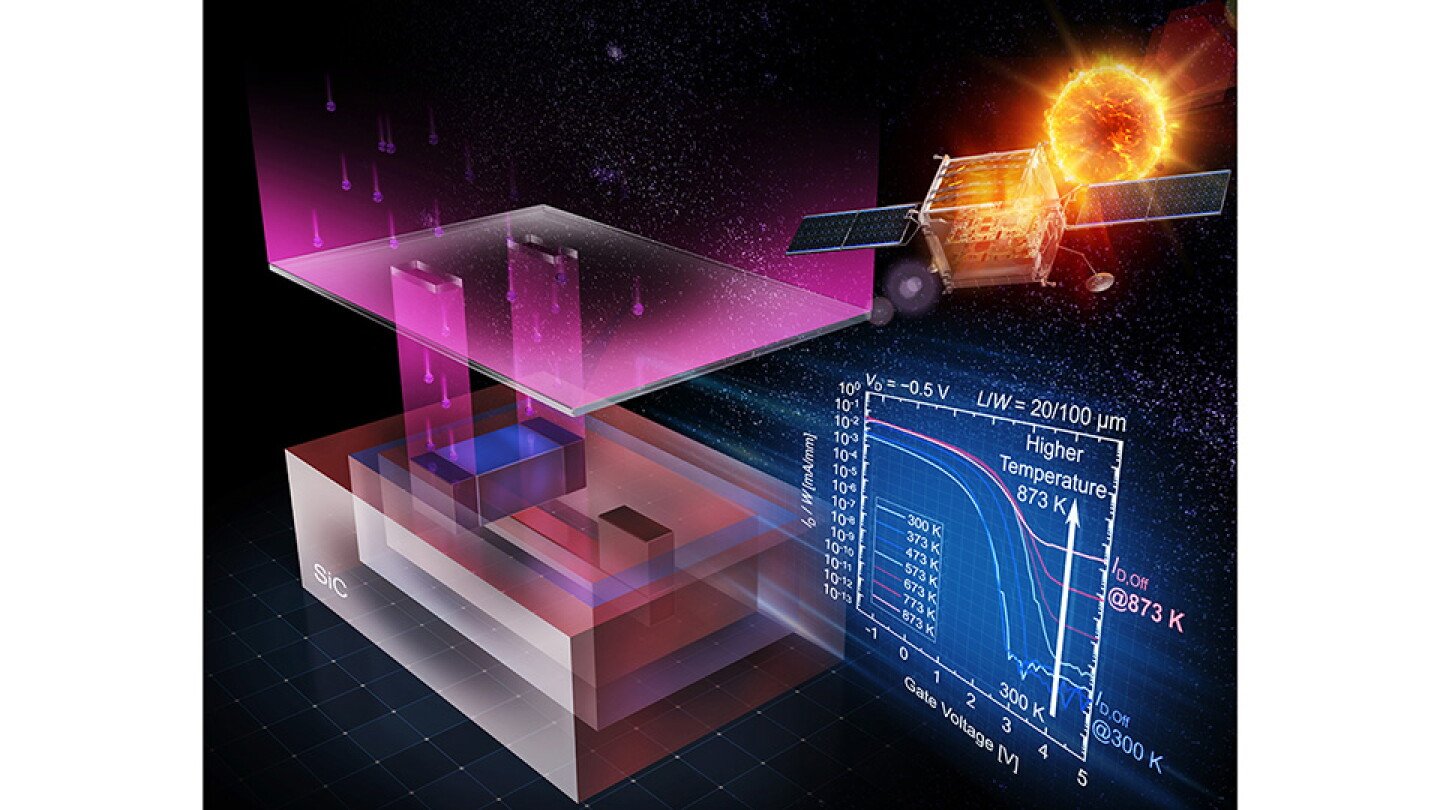
The new transistor, detailed in the journal APL Electronic Devices, achieves sub-0.1V threshold accuracy and an order-of-magnitude reduction in leakage current, paving the way for robust and efficient silicon carbide circuits capable of sustained operation at temperatures exceeding 600°C. This breakthrough is particularly significant for industries where conventional silicon-based electronics falter under extreme heat.
Silicon carbide is a semiconductor material renowned for its inherent ability to operate under challenging conditions, making it a cornerstone for high-power and high-temperature applications. However, existing junction-based SiC devices have struggled with two critical issues: unpredictable threshold voltages and substantial current leakage at elevated temperatures. These problems have historically hampered their performance and limited their widespread adoption in the most demanding environments.
"Our new transistor directly tackles both of these fundamental challenges," explains lead author Mitsuaki Kaneko. "By strategically placing the transistor’s gate below the channel – a departure from conventional designs where it’s typically above – we effectively mitigate the distortion caused by ion channeling during the implantation process. This innovative structural change is key to our improved performance."
The research team, led by Kaneko, Shunya Shibata, and Tsunenobu Kimoto, fabricated their novel transistors using selective ion implantation into 4H-SiC, a widely used polytype of silicon carbide. To meticulously evaluate their design, they created two variants: one on a semi-insulating substrate to precisely measure threshold voltage control, and another engineered to minimize current leakage by electrically isolating the transistor from its surroundings.
The results were remarkable. The new transistors demonstrated unprecedented precise threshold-voltage control, exhibiting only a 0.1V deviation even at a scorching 400°C. Even more impressively, their low leakage suppression at high temperatures was a game-changer. At 600°C, the measured leakage current was an astounding order of magnitude lower than that of conventional devices operating at a comparatively cooler 400°C.
Further analysis revealed a crucial insight: the residual leakage current observed was primarily dictated by silicon carbide’s intrinsic thermal-generation limit, indicated by an activation energy approximately half of the material’s bandgap. This suggests that the researchers have pushed the leakage performance close to the theoretical limits of the material itself.
The ability of these transistors to maintain a normally-off state at operational temperatures is a crucial prerequisite for developing energy-efficient low-power logic circuits. Looking ahead, the research team plans to refine the device design to further optimize this capability. Future work will also include rigorous testing of the transistor’s long-term stability and its integration into complete systems, moving closer to real-world applications.
This breakthrough marks a significant leap forward in the development of robust, reliable, and efficient electronics for extreme environments. As industries increasingly demand components that can withstand intense heat and harsh conditions, this new silicon carbide transistor offers a promising solution to power the next generation of advanced technologies.
Source: "Over 600°C operation of ion-implantation-based SiC bottom-gate JFETs," by Mitsuaki Kaneko, Shunya Shibata, and Tsunenobu Kimoto, APL Electronic Devices (2026). The full article is accessible at https://doi.org/10.1063/5.0346734. This paper is part of the Electronic Devices with High Operating Temperature (> 500 °C) Collection.