






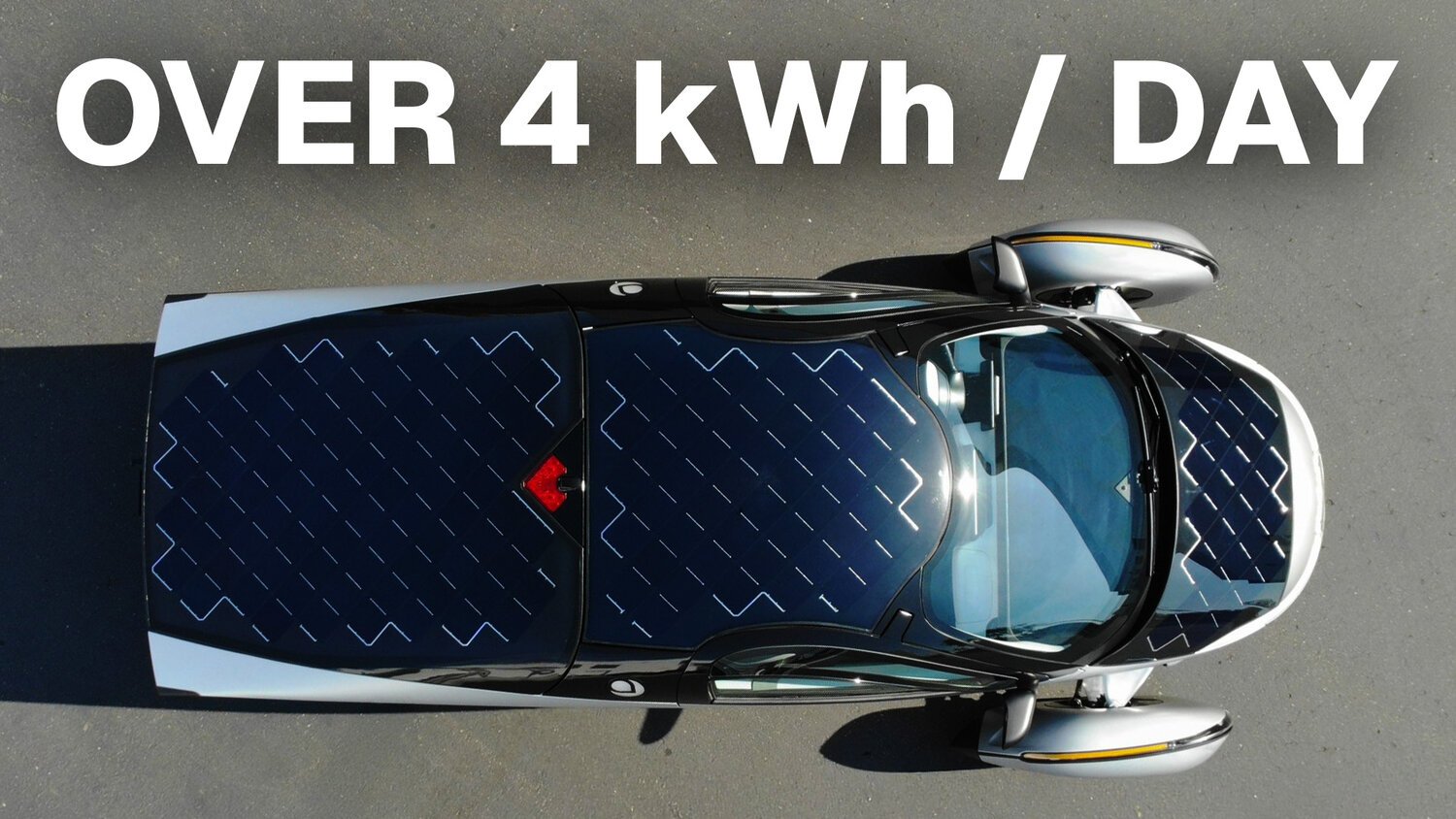
Aptera has cleared a significant milestone in the development of its solar electric vehicle (SEV), with independent testing confirming that its proprietary solar technology can generate more than 4 kilowatt-hours (kWh) of usable energy in a single day. The validation, conducted by global testing organization TÜV Rheinland at Aptera’s facility in Carlsbad, California, provides a crucial third-party metric for the viability of vehicle-integrated solar technology.
During the three-day testing period in July, engineers used calibrated equipment to measure the actual energy flow into the vehicle’s battery after accounting for conversion losses. This distinction is vital in the field of automotive solar; unlike rooftop installations, vehicle-integrated systems must overcome inherent challenges such as limited surface area, fluctuating angles, and the impact of partial shading. The test results confirm that Aptera’s integrated system of curved solar panels, power distribution architecture, and firmware performed as a cohesive unit.
The findings showed that even in a fixed, stationary position, the vehicle generated 4.23 kWh of usable energy between sunrise and sunset. Aptera estimates that this energy volume supports approximately 42 miles of driving, assuming the vehicle reaches its target efficiency of 100 watt-hours per mile. When researchers repositioned the vehicle once at solar noon, generation increased to 4.40 kWh, and by angling the rear hatch toward the sun, the output rose to 4.75 kWh—potentially extending the solar-only range to 47 miles.
For the automotive industry and fleet operators, the fixed-position test is of particular interest. It reflects a realistic “set it and forget it” scenario in which a commuter or commercial worker leaves a vehicle parked throughout the day without the ability to track the sun’s movement.
However, industry analysts note that while these figures are promising, they represent a snapshot of high-performance conditions. Because the testing occurred in Southern California during the summer, the results do not guarantee similar performance across different latitudes, seasons, or weather patterns. Furthermore, the mileage figures remain theoretical projections based on Aptera’s internal efficiency goals rather than empirical road-test data.
As Aptera transitions toward commercial production, the company faces the broader challenge of scaling this technology. Consistency will be the next major hurdle; the firm must prove that the performance seen in a single, controlled validation vehicle can be replicated across a high-volume production line. Beyond the solar array itself, the company must also navigate the standard rigors of automotive manufacturing, including supply chain management, component integration, and regulatory compliance.
The potential for solar-augmented driving is a compelling proposition for the EV market, particularly for businesses looking to lower the carbon footprint of their fleets. By tapping into ambient sunlight, vehicles could potentially offset a significant portion of daily grid-based charging. However, the commercial viability of the technology will ultimately depend on whether the system can deliver a consistent return on investment once the costs of specialized solar hardware are weighed against energy savings and operating benefits.
For now, the TÜV Rheinland report serves as an important proof-of-concept. It demonstrates that under favorable conditions, vehicle-integrated solar is not merely an aesthetic addition but a functional power source capable of contributing meaningfully to an EV’s daily range. As Aptera moves closer to full-scale manufacturing, these performance metrics will serve as a baseline for future comparisons, setting the stage for more complex real-world testing across diverse operational environments.
Disclaimer: This content is auto-generated for informational purposes only.
Source: Read Original News