




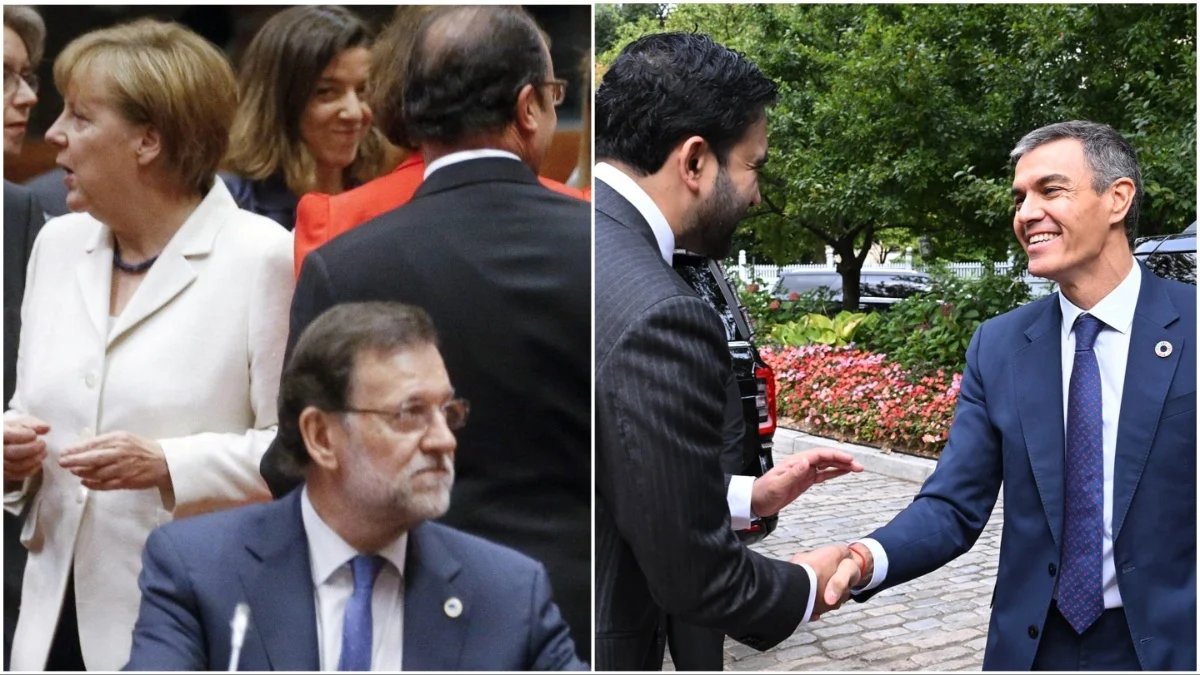
It may seem hard to believe, but Pedro Sanchez is the first prime minister of Spain who can actually speak English. He has been putting these linguistic skills to good use while in New York for the United Nations General Assembly, where he has been seen rubbing shoulders with his international counterparts.
Sanchez’s recent visit saw him take a stroll through Central Park with new UK Prime Minister Andy Burnham, where the pair attempted to strike up a slightly forced bromance, chatting entirely in English. The Spanish premier also filmed a lighthearted segment shooting paper ball “hoops” with New York Mayor Mamdani Zohran, joking that “being a leftist means taking big shots.”
As slightly cringey as some of these appearances may have been, they represent a breath of fresh air for Spanish diplomacy. Long gone are the days of Spanish prime ministers sitting forlornly on the world stage, isolated by a language barrier while other leaders mingle in convivial side huddles.
His predecessors notoriously shied away from English in public, relying heavily on interpreters. Most famous among them was former Partido Popular (PP) leader Mariano Rajoy, who famously fumbled a 2017 exchange with a BBC reporter. When asked a question about Brexit in English, Rajoy responded awkwardly in Spanish: “Bueno hombre, no vamos a hacer esto” (“Well, no, we won’t be doing that now”), before hurriedly giving the floor to another journalist.
The contrast with the current administration is stark. Sanchez, 54, polished his English during a 1997 stint at the Office of the High Representative in Bosnia and Herzegovina. He is part of a growing cohort of progressive politicians in Spain who are remarkably comfortable in the international arena.
Economy Minister Carlos Cuerpo, 46, is perhaps the most fluent, frequently appearing on CNN to discuss market movements with a level of vocabulary that would be the envy of many native speakers. A graduate of the London School of Economics, Cuerpo also speaks French and recently addressed an audience in Tokyo in Japanese. Similarly, Foreign Minister Jose Manuel Albares, a career diplomat, boasts impeccable English, having spent years working in Paris before serving as ambassador.
However, this linguistic aptitude seems to stop at the ideological divide. The political right in Spain remains notoriously monolingual. PP leader Alberto Nuñez Feijoo has admitted his English is “badly” (sic) and relies on mobile translation apps. Meanwhile, Madrid President Isabel Diaz Ayuso—often dubbed “Spain’s Margaret Thatcher”—lacks the Iron Lady’s command of foreign tongues, joking that her vocabulary is limited to basic greetings.
Many political analysts point to the lingering legacy of the Franco regime. In 1941, General Franco mandated the dubbing of all foreign films into Castilian, effectively insulating generations of Spaniards from the English language. While the country struggles to shake off this cultural insularity, the current political divide suggests that for Spain’s future in the global arena, the ability to speak English is increasingly becoming a party-political asset.
Disclaimer: This content is auto-generated for informational purposes only.
Source: Read Original News