








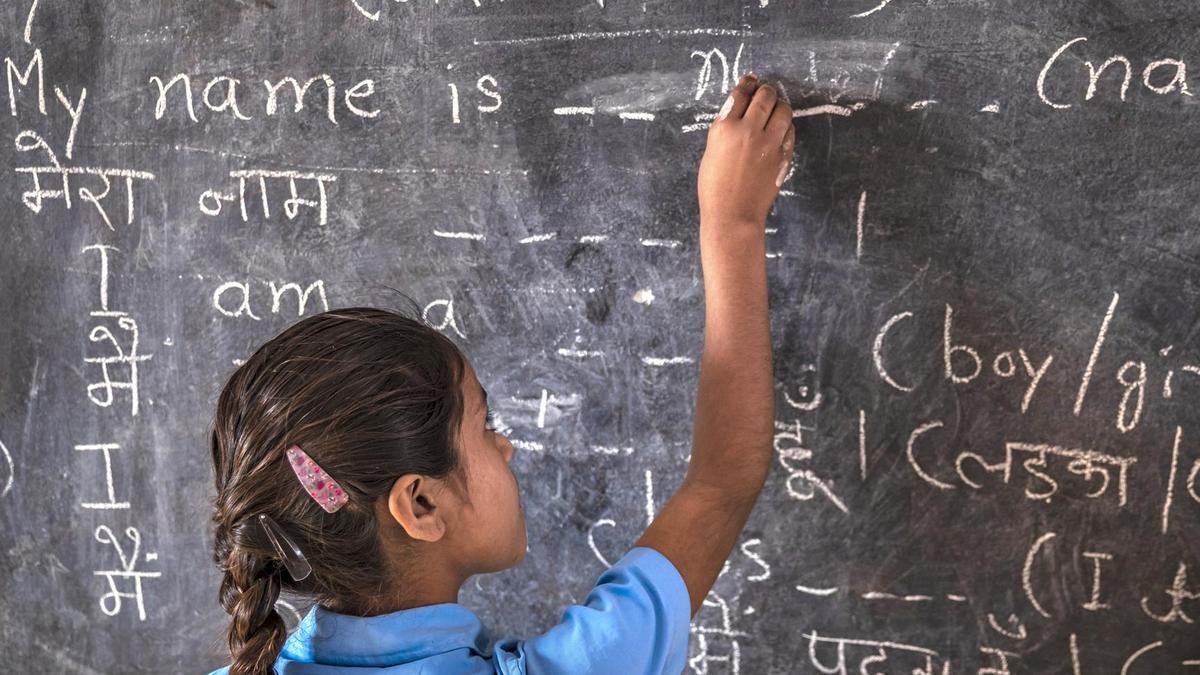
The implementation of the three-language policy under the National Education Policy (NEP) 2020 is currently reshaping the academic landscape of CBSE schools across India. With the mandate to include two Indian languages (Bhartiya Bhashas) starting from Class 6 in the 2026–27 academic session, schools are navigating a complex transition characterized by logistical challenges, pedagogical shifts, and varying degrees of regional readiness.
The Structural Shift in Language Learning
For most urban CBSE schools, English serves as the primary medium of instruction (R1). The new policy requires that the remaining two language slots (R2 and R3) be filled by Indian languages. This shift naturally reduces the space previously allocated to foreign languages, which many institutions had integrated into their curriculum. While the Supreme Court has taken note of the policy’s implementation—specifically regarding the treatment of English and the recent reprieves granted to students in Classes 7 through 9—the academic community remains in a state of adjustment.
Principals note that while the intent to promote multilingualism is widely supported, the “on-the-ground” reality involves significant friction. Schools are currently managing a delicate balance: adhering to the new mandate while attempting to protect the continuity of students who had already begun studying foreign languages.
Institutional Challenges: Teachers and Resources
A primary hurdle in the policy’s rollout is the acute shortage of qualified teachers for a diverse range of regional languages. In many parts of Northern India, for instance, schools are defaulting to Sanskrit as the third language (R3) simply because there is a lack of instructors for other regional options.
“Teaching students with widely different levels of proficiency in the same classroom is a genuine hurdle,” notes Dr. Sudha Acharya, Principal of ITL Public School, Dwarka. Educators emphasize that adding a third language to the Class 9 curriculum—already a high-pressure year with ten subjects—increases the academic load significantly. Furthermore, the lack of clearly defined Learning Outcomes (LO) and the scarcity of standardized textbooks for these new language combinations have created uncertainty for both parents and students.
Pedagogy vs. Examination
The central concern for educators is whether this policy will foster genuine linguistic proficiency or merely create “multilingual examination candidates.” Teachers argue that language acquisition is most effective when it is functional and experiential, rather than a rote-memorization exercise for board exams.
Munmun Sengupta, Principal Learner Incharge at Delhi Public School, Varanasi, points out that while the policy builds cultural grounding, its success depends on moving beyond examination-centric models. Some schools are attempting to bridge this gap by offering foreign language enrichment through “Saturday Clubs” or “bagless days,” ensuring that students retain global exposure without violating the core requirements of the NEP.
Building a “Glocal” Citizen
The long-term vision of the NEP is to create “glocal” citizens—individuals who are rooted in their own culture yet capable of navigating an interconnected world. Experts suggest that the ideal framework is one where Indian languages and foreign languages coexist. As Vaishnavi S. of the Vivekananda Educational Trust notes, the objective should not be to replace one with the other, but to treat multilingualism as a lived skill.
Schools that have successfully implemented trilingual frameworks—such as those in Punjab (English, Hindi, Punjabi) or Karnataka—serve as potential models for the rest of the country. However, as the 2026–27 session approaches, the consensus among academic leaders is clear: the success of the three-language policy will not be measured by the number of languages on a report card, but by the ability of students to communicate, reason, and empathize across linguistic boundaries. For now, the transition remains a work in progress, requiring more robust teacher deployment and clearer assessment guidelines to ensure that this cultural investment yields tangible academic results.
Disclaimer: This content is auto-generated for informational purposes only.
Source: Read Original News