






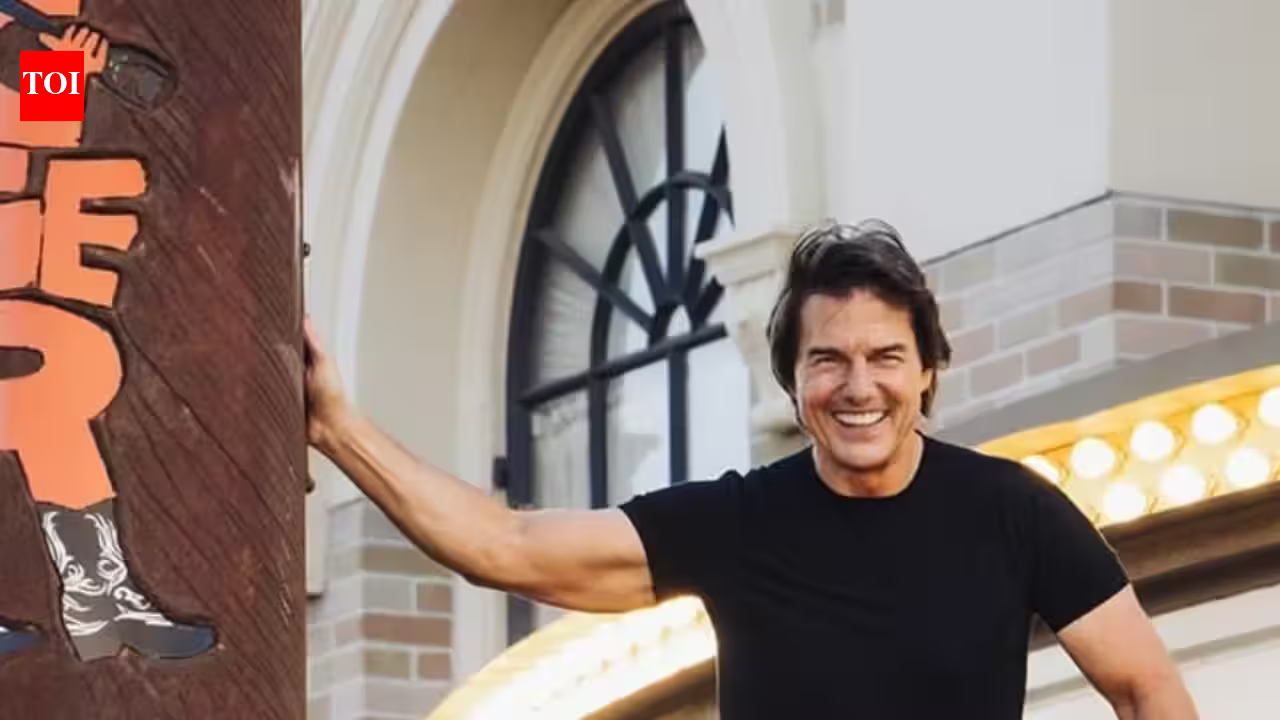
In an era where movie magic is increasingly synonymous with green screens and CGI touch-ups, Tom Cruise remains the industry’s final, stubborn bastion of practical insanity. Whether he is clinging to the side of a departing cargo plane or piloting a fighter jet through high-G maneuvers, Cruise has turned the act of “doing it for real” into a personal brand that has no equal. But behind the death-defying jumps and the calculated adrenaline is a man who has spent decades contemplating exactly what he is risking.
In a recent, introspective conversation with GQ, the superstar pulled back the curtain on the psyche that drives his legendary career. While fans often marvel at the physicality of his stunts, Cruise suggests that the cliff-hanging, high-altitude leaps are merely manifestations of a deeper, existential curiosity.
The Cliff’s Edge: A Metaphor for Existence
When you spend your life doing things that most people consider a quick route to an early grave, the question of mortality becomes inevitable. During his interview, Cruise didn’t dodge the query about his relationship with death. Instead, he framed his entire life—and by extension, his career—as a continuous exercise in edge-walking.
“Look, I think you could look at my life and go, ‘I like standing on the edge of a cliff physically and metaphorically,'” Cruise shared. For the 62-year-old actor, the “edge” isn’t just a place to hang a camera; it is a point of engagement with the world. He views his life not as a series of safe, measured steps, but as a sprawling adventure fueled by a restless desire to understand the human condition.
He speaks with a candor that defies the polished veneer of Hollywood stardom. For Cruise, the goal has always been connection—transcending borders, languages, and cultures through the medium of cinema. “I want to understand people,” he said. “I want to understand life and cultures. I wonder what those people are and how they feel. Do they think the way I do? Do they laugh at the same thing?”
Reframing Fear as Fuel
Perhaps the most fascinating insight from the discussion was his perspective on the nature of fear itself. Many would assume that a man who has jumped a motorcycle off a Norwegian mountain must be devoid of the typical human “fight or flight” response. Cruise, however, pushes back against that idea. He isn’t fearless; he is simply someone who has learned to stop running from the discomfort of uncertainty.
“So do I fear death? No, I don’t. But I don’t mind. It’s not like I’m not afraid,” he explained. By embracing that inherent human fear, he transforms it from an inhibitor into an instrument. In his world, life is a delicate balance of “certainties and uncertainties.” His process as a filmmaker is to systematically solve the uncertain problems, only to immediately introduce new, more daunting challenges to keep the momentum going.
“I’m not afraid to feel afraid,” he noted, a sentiment that feels like the foundational thesis of his entire life. It is the admission of a man who knows that the “leap” is the only thing that separates the stagnant from the extraordinary. He doesn’t ignore his fear; he stares it down, acknowledges the validity of the risk, and decides that the adventure is worth the price of admission.
Stepping Into the Shoes of a Billionaire Villain
Transitioning from the death-defying heroics of Ethan Hunt, Cruise is set to pivot into a role that explores the darker side of power in the upcoming film, Digger. The project marks a departure from the traditional “save the world” hero archetype we’ve come to expect from the actor. In Digger, Cruise steps into the shoes of a potbellied, world-dominating billionaire—a man whose industrial ambition carries a heavy cost.
The premise sounds like a cautionary tale of hubris: Cruise’s character is a tycoon whose massive drilling operations trigger a catastrophic environmental shift, leading to a tsunami that devastates a continent. It is a stark shift for an actor who has spent the last two decades positioning himself as the ultimate savior of cinema. Here, he is the architect of the apocalypse.
However, the film promises the classic Cruise arc: redemption through extreme effort. As the character attempts to clean up the mess he has created, he is forced to reckon with his legacy and his influence on the planet. It is a juicy, complex role that requires the same intensity he brings to his stunts, albeit channeled into the moral ambiguity of a global powerhouse.
The Eternal Apprentice
What truly keeps Tom Cruise relevant isn’t just the stunts; it’s the fact that he still carries the hunger of a newcomer. He talks about his work not as a job he has mastered, but as a continuous study of life. Every project, whether it’s a high-octane Mission: Impossible installment or the morally dense Digger, is an attempt to bridge the gap between himself and the audience.
By continuously putting himself in vulnerable positions—whether that means hanging from a wire or taking on a character who is fundamentally flawed—Cruise is proving that he hasn’t lost his edge. He is still standing on that metaphorical cliff, looking out at the horizon, waiting to see what happens next. In an industry that often favors safety and repetition, Cruise’s refusal to stop feeling “afraid” is exactly what keeps him at the top of the mountain. He isn’t just making movies; he is refining his philosophy, one leap at a time.
Disclaimer: This content is auto-generated for informational purposes only.
Source: Read Original News