







6 min readJun 27, 2026 12:05 PM IST
First published on: Jun 27, 2026 at 12:04 PM IST
Many may claim to be Indophiles but theatre director and filmmaker Habib Naghmouchin lives as one. Whether spending 12-hour days in rehearsal halls at Delhi’s Shri Ram Centre for Performing Arts (SRCPA) or being on the road documenting India’s diverse soils with his camera, the French artiste has found an enduring conversation here that keeps his eyes ever curious. Yet one fascination remains constant wherever he goes: Shakespeare, and Hamlet in particular. So much so that he is now directing the tragedy in Hindi despite never having formally learnt the language.
“Shakespeare is dynamic. Each of his characters can slip into any context and geography and yet remain relevant,” says Naghmouchin, whose artistic journey has been shaped by collaborations with theatre giants Peter Brook and Ariane Mnouchkine. “Hamlet is a language of emotion. What matters are the vibrations of the actors I work with,” says the director, who plays both the flute and piano, and instinctively responds to sound and rhythm. The French avant garde director is in Delhi at the invitation of SRCPA for his Hindi debut because he wanted to contemporise Shakespeare in a foreign language. For many directors, staging Hamlet in an unfamiliar language would be daunting. But Naghmouchin is remarkably pragmatic about it. Having worked on Shakespeare for years, he knows the play intimately. The Hindi script has been vetted by ex-NSD theatre practitioner Chinmay Das while rehearsals are built around long readings and emotional exploration rather than linguistic precision. “Often there is confusion over the words,” he says. “But we can understand the text by looking at the emotion of the actor. Emotion is universal and the truth of the actor is universal.”

That search for emotional truth shapes his reading of Shakespeare’s most discussed protagonist. While Hamlet is often viewed as a paralysed prince incapable of action, Naghmouchin sees him differently. “The play is complex but not complicated,” he says. What makes Hamlet enduring, he argues, is not indecision but inquiry. “There is a difference between doubt and dilemma. Hamlet has doubt, not a dilemma. And he asks questions of established structures by staying within the system, not abandoning it or turning into a rebel. He represents not the power we inherit but the power we choose to seize. How many of us can ask questions of power to authoritative regimes?”, he asks. In an age of instant outrage and rigidities, that quality feels contemporary.
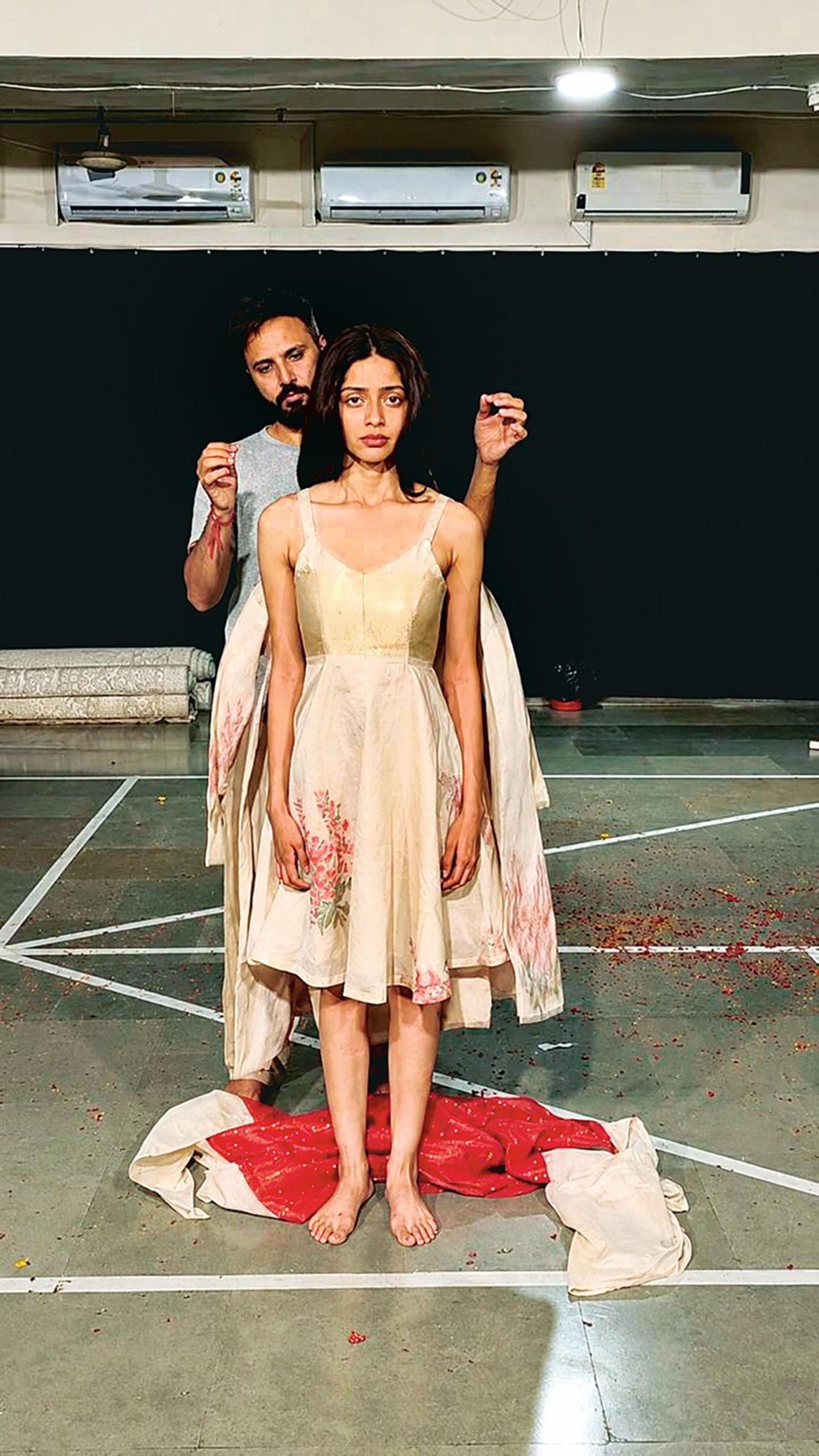 Hamlet and Ophelia on stage
Naghmouchin believes the play resonates deeply with present-day India and the wider world because it interrogates power, corruption and moral responsibility. Drawing parallels with the Mahabharata, he sees Hamlet wrestling with a timeless question: how does one seek justice without blackening one’s soul? “And although Hamlet gets sucked in by circumstance to act in a predictable way, he knows he is slipping. He is self-aware,” says the director.
The production itself strips away period grandeur in favour of contemporary immediacy. Performed by a young repertory whose actors are in their early 20s, the play rejects romantic notions of Shakespearean tragedy. “My first task is to tell the story truthfully and simply,” he says. “These actors come from today’s social reality, so I ask them to be true to that reality.” Rather than presenting Hamlet as a distant classical figure, Naghmouchin views him as a young man overwhelmed by forces larger than himself, struggling to navigate a chaotic world. “I work with youth because I see hope in them as evidenced by youth-led movements globally. They can imagine another possibility. If they lose hope too, we will be lost forever,” he says.
With identity politics, polarisation, conspiracy theories and declining trust in institutions shaping public life globally, many theatre lovers have described our times as Hamlet-like. “Do we need a Hamlet today? Absolutely,” he says. Yet he rejects simplistic hero worship. Hamlet’s integrity lies not in moral purity but in his willingness to engage with difficult questions. “He goes to the end of the journey,” Naghmouchin says. “He gets pulled into conflict. He reacts to context. The important thing is what he chooses to do with what is thrown at him.”
His interpretation also foregrounds the contradictions at the heart of the prince. Hamlet speaks luminescently of love, yet contributes to the destruction of both his lover Ophelia and mother Gertrude. “That is the paradox. Both are judged, become objects of Hamlet’s anger and are denied full control over their circumstances. And both die.” In fact, Naghmouchin wonders why Shakespeare sacrificed the two women. Across Europe, he notes, some actresses have become reluctant to play Ophelia or Gertrude because of the violence directed at them within the narrative.
Naghmouchin has absorbed lessons from two of modern theatre’s greatest directors. Mnouchkine, founder of Théâtre du Soleil, taught him the art of observation, making him sit beside her in silence for six months. Brook, by contrast, embodied generosity. “He would ask, ‘What do you think of the scene? How were the actors today?’” recalls Naghmouchin. Brook believed theatre itself was a space free of simplistic notions of good and evil. Those influences are visible in a production that draws lightly on Indian aesthetics. The stage is spare, furnished with Kashmiri carpets, while the music incorporates sitar, sarod and the evocative strains of Raag Bhimpalasi.
Ultimately, Naghmouchin’s Hamlet is less about a prince seeking revenge than about a human being confronting the consequences of choice. “He is wise,” the director says, “but he becomes a victim of circumstances. He cannot always control his actions. Still, he keeps seeking answers.” For Naghmouchin, that act of questioning may be the most radical form of action of all.
The play will be staged at SRCPA, New Delhi, July 3-5