




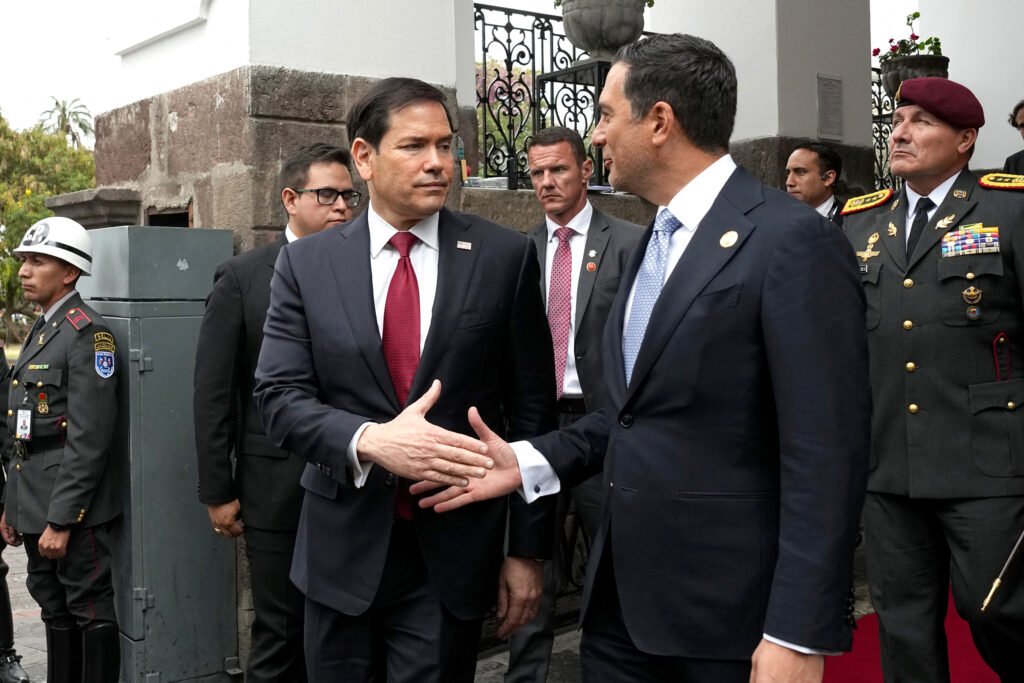
Secretary of State Marco Rubio’s tour of South America this week has underscored a shift in U.S. regional policy, as Washington aggressively pushes for access to critical minerals and an expanded military presence. However, this strategic pivot—framed as a counter to Chinese influence—is facing intense scrutiny from environmental and human rights advocates, who fear it will exacerbate violence against those protecting the Amazon and other vulnerable ecosystems.
Rubio’s itinerary includes high-level meetings with the leaders of Colombia, Ecuador and Peru—three nations recently captured by right-wing governments built on hard-line security platforms. In Colombia, the Secretary of State met with President Abelardo de la Espriella to sign a bilateral agreement on critical minerals and civil nuclear cooperation. The pact, which promises to fast-track mining projects through streamlined permitting and financial support, aligns with the Trump administration’s designation of resources like silver and copper as national security imperatives.
For environmental defenders on the ground, the “national security” framing is cause for alarm. Colombia is frequently ranked as the world’s deadliest country for environmental activists, with organizations like Global Witness documenting 48 killings in 2024 alone. Critics argue that when states categorize mining as a security priority, they effectively legitimize the suppression of dissent. In regions where land disputes and organized crime already overlap, accelerated industrial extraction often translates into increased threats and state-sanctioned repression.
The U.S. State Department has remained silent on whether these new mining agreements include provisions to respect Indigenous peoples’ rights to “free, prior and informed consent”—a standard that has often been overlooked in the current pursuit of minerals. This follows a broader trend; an investigation by Inside Climate News found that the U.S. government recently removed critical reporting on Indigenous rights abuses from its annual human rights assessments.
“The risk is that there are now three Trump-aligned presidents in the upper Amazon and Secretary of State Marco Rubio is flying around trying to cut reckless deals which are essentially about the wholesale extraction of minerals from the largest rainforest on earth,” said Mitch Anderson, executive director of the nonprofit Amazon Frontlines.
The security component of Rubio’s agenda is equally contentious. In Ecuador, President Daniel Noboa has institutionalized a militarized approach to law enforcement, authorizing the deployment of troops to guard “strategic” mining sites. These policies have been accompanied by a crackdown on civil society, including the freezing of bank accounts belonging to dozens of leading environmental and Indigenous activists. During protests in 2025, at least three people were killed, including an Indigenous land defender, during a military-led response to national strikes.
While the U.S. government maintains that its security partnerships are designed to combat transnational criminal organizations, human rights watchdogs, including Human Rights Watch, have questioned the nature of these interventions. Recent military operations, including joint U.S.-Ecuadorian actions, have resulted in civilian casualties and sparked allegations of extrajudicial killings.
As Rubio moves to Peru to meet with President Keiko Fujimori, local communities are bracing for similar pressure. Activists in Peru warn of an “invasion” of illegal mining that has already rendered many river basins in the Loreto region dangerous zones characterized by deforestation, human trafficking, and the active persecution of those who attempt to defend their territories.
For many Indigenous nations, the struggle is existential. Communities across the Amazon have spent nearly two decades fighting to enshrine the “rights of nature” in national constitutions, seeking to protect ecosystems as living entities rather than simple resource reservoirs. As the U.S. pushes to deepen its footprint in the region, those communities now find themselves at a precarious crossroads, caught between the encroachment of global industry and the hardening security policies of their own governments.
When questioned about concerns that U.S. interests prioritize extraction over local autonomy, Rubio defended the partnerships as a necessary alternative to Chinese, Russian, or Iranian influence in the hemisphere. Yet, for those living on the front lines of the extractive frontier, the current trajectory suggests a future defined by heightened conflict and the systematic dismantling of environmental protections.
Disclaimer: This content is auto-generated for informational purposes only.
Source: Read Original News