






Europe Ablaze: A Continent Grapples with Unprecedented Wildfires and a Looming Climate Catastrophe
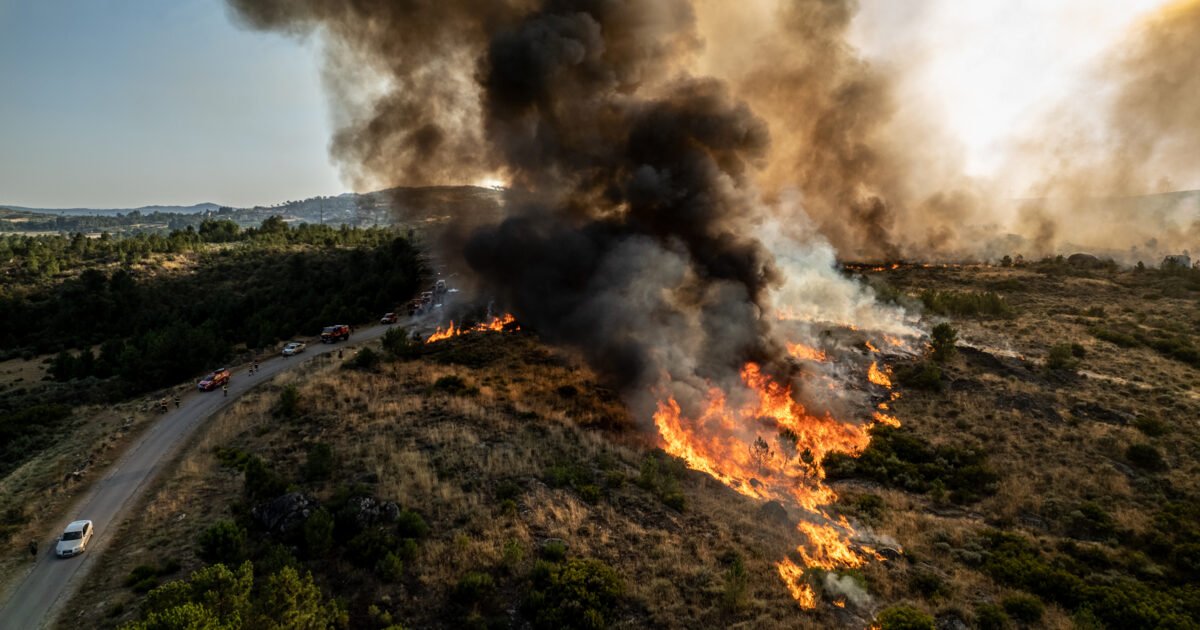
Europe is currently enduring a summer of unparalleled climate crisis, with devastating wildfires ravaging Spain and France, forcing mass evacuations, and leaving a trail of destruction. French President Emmanuel Macron has described the situation as the "most severe" the country has faced since World War II, a stark declaration that underscores the escalating threat posed by a rapidly warming planet.
The apocalyptic scenes unfolding across the continent serve as a grim reminder of humanity’s ongoing "war with ourselves," a battle fueled by an insatiable addiction to fossil fuels and the relentless exploitation of Earth’s finite resources. This destructive path has already claimed countless lives, decimated precious ecosystems, and pushed the global climate further out of balance than ever before.
According to the World Meteorological Organization’s State of the Global Climate 2025 report, the period between 2015 and 2025 marks the hottest 11 years on record, a clear indicator of the accelerating climate crisis. The undeniable culprit remains humanity’s persistent carbon emissions. The UN Environment Programme’s Emissions Gap Report 2025 reveals that nations are dangerously off track in their commitment to limit global heating to the Paris Agreement’s target of 1.5°C. Current Nationally Determined Contributions (NDCs) project a warming of 2.2°C–2.5°C, while existing policies point towards a catastrophic 2.8°C increase. The recent withdrawal of the United States, the world’s second-largest emitter, from international climate agreements only exacerbates this critical shortfall.
The planet is already teetering on the edge. 2024 marked the hottest year on record, breaching the 1.5°C threshold by reaching 1.55°C above pre-industrial levels. While monthly or annual averages exceeding this limit do not signify an immediate failure of the Paris Agreement, they are a stark warning of humanity’s rapid approach towards irreversible climate tipping points.
The consequences of this warming are far-reaching and devastating. Over 91% of the excess heat generated by emissions has been absorbed by the oceans, severely compromising their capacity to regulate the climate and pushing critical ecological systems to the brink. Glaciers, the Antarctic ice sheets, and Arctic sea ice are melting at alarming rates, reaching unprecedented lows in recent years. This has contributed to globally significant phenomena like the "Super El Niño," which is unleashing widespread damage across multiple regions. Furthermore, scientific observations now confirm a slowing of the Atlantic Meridional Overturning Circulation (AMOC), a crucial ocean current that governs heat distribution. A complete shutdown of the AMOC would have catastrophic consequences for global climate patterns, a scenario experts increasingly view as a terrifying possibility.
This summer’s extreme heatwaves are a direct manifestation of these escalating climate impacts. June registered as Western Europe’s hottest on record, driven by unprecedented sea surface temperatures. This intense heat directly contributed to over 10,000 excess heat-related deaths in Europe during the June heatwave, with over 9,000 of these fatalities occurring among individuals aged 65 and over. The resulting dryness and exacerbation of drought conditions created the perfect tinderbox for the infernos raging across Spain and France. These dangerous and unpredictable fires have consumed vast swathes of land, spreading with alarming speed and even generating rare "pyrocumulonimbus clouds" or "fire clouds," which create their own wind and lightning, further intensifying their destructive power.
The human toll of these wildfires is immense. An estimated 375,000 people across Spain and France have been forced to evacuate their homes, and predictions suggest these fires could continue to burn until early November. The long-term impacts will be severe, including destroyed homes, scorched land, ruined local economies, devastated agricultural production, and skies choked with hazardous smoke.
The path forward demands immediate and forceful action, far beyond mere rhetoric from world leaders. The time for words is over; concrete action is paramount. This necessitates:
- Ending fossil fuel subsidies with binding, near-term phase-out schedules, prioritizing the most carbon-intensive projects and closing loopholes that enable "transition" gas projects to be classified as green investments.
- Halting all new fossil fuel infrastructure permits. No new licenses for oil, gas, or coal exploration should be issued, as every approval today represents a broken promise for tomorrow.
- Massively scaling up renewable energy production. This requires upgrading local, national, and international energy transmission systems and facilitating renewable micro-production for individual households to foster greater energy independence.
- Funding adaptation and resilience at the scale of the risk, not the politics. Dedicated, ring-fenced climate finance for disaster risk reduction, early warning systems, and support for vulnerable populations during heatwaves must be prioritized over discretionary spending.
- Protecting and restoring ecosystems as frontline infrastructure. Wetlands, forests, and healthy soils are crucial for reducing fire and flood risks and should be funded and legislated as critical infrastructure, not optional "nice-to-haves." The ocean, the "blue beating heart of our planet," also demands urgent protection and restoration.
- Removing polluting industries from climate negotiating rooms. Fossil fuel lobbyists should not be allowed to influence policies designed to phase out their own industries. Robust conflict-of-interest rules for climate negotiations are long overdue.
Industry also bears a significant responsibility and cannot afford to wait for government mandates. Businesses must:
- Publish credible, science-based transition plans with verifiable and independently audited interim targets for 2027 and 2030, moving beyond mere 2050 net-zero pledges towards achieving "real-zero" emissions.
- Cut emissions across their entire supply chains, including tackling Scope 3 (indirect) emissions, which represent the bulk of the carbon footprint for sectors like fashion, food, and shipping.
- Cease financing fossil fuel expansion. Banks and insurers must end underwriting for new oil and gas projects and redirect capital towards renewables, grid upgrades, and nature-based solutions. The economic case is clear: 91% of renewable energy is now cheaper than fossil fuel alternatives.
- Integrate climate risk into core business planning, encompassing supply chain resilience and workforce safety during extreme heat, rather than relegating it to a side project of sustainability teams.
- Actively support, not obstruct, ambitious climate regulation. Businesses committed to a sustainable future should lobby for stronger climate policies, not secretly fund trade associations that undermine them.
- Invest proactively in the future, focusing on the production, distribution, efficiency, and storage of renewable energy.
The current trajectory is a recipe for disaster, promising violence, starvation, mass forced migration, war, and widespread death. Current actions are woefully insufficient given the urgency of the moment. However, a better future remains within reach. The economic arguments for a rapid transition are growing stronger, as evidenced by the flatlining or falling CO2 emissions in China, driven by significant investments in renewables.
This is not a narrative of sacrifice. Protecting ecosystems and phasing out fossil fuels are essential for safeguarding livelihoods and building robust, resilient economies. Effective climate action is not a "cost" but rather the greatest cost-saving measure in human history.
The global heating that is fueling Europe’s devastating fires and droughts will only intensify unless humanity acts with the necessary force. As UN climate chief Simon Stiell powerfully stated, "The climate alarm is blaring, from every direction." It is now imperative that we demand our leaders – and the businesses that influence them – respond with the force, speed, and scale required to avert a global catastrophe.