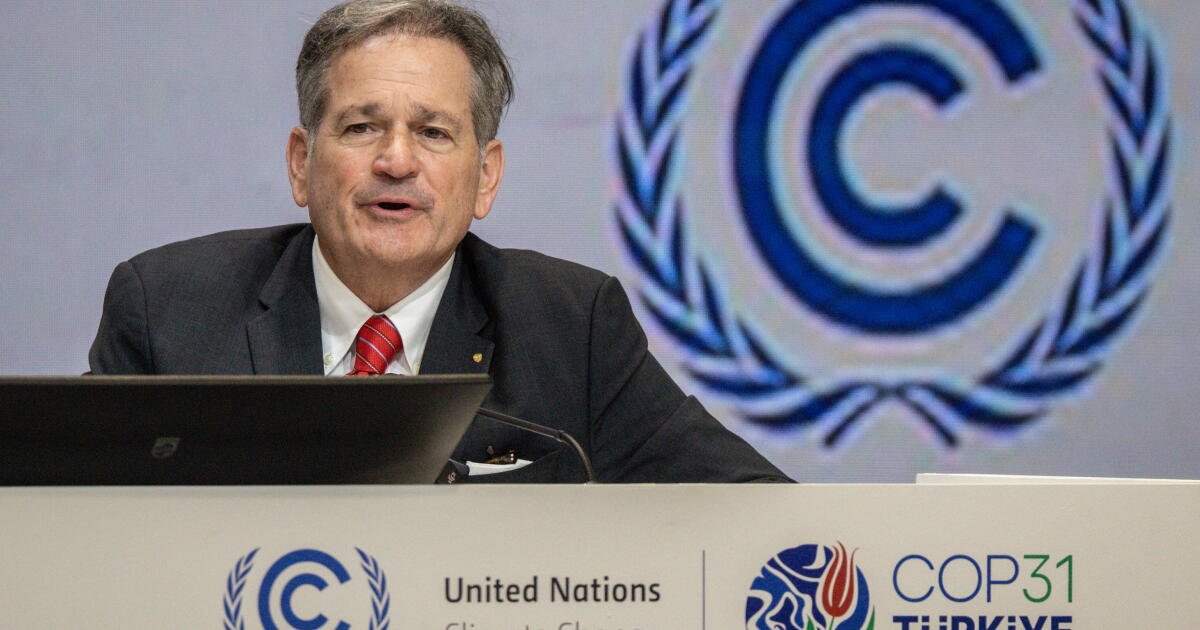








ANTALYA, Turkey—As the United Nations COP31 climate summit enters its final stretch, the prospect of a unified global agreement hangs in the balance. Tensions have reached a fever pitch following an ultimatum from Panama, which has threatened to block any final deal that fails to provide a concrete roadmap for a fossil fuel phase-out.
In a formal letter delivered Thursday to Simon Stiell, executive secretary of the UN Framework Convention on Climate Change (UNFCCC), Panama’s Minister of the Environment, Juan Carlos Navarro, declared that his nation would refuse to sign any consensus “that does not lead to an outcome satisfactory to our principles and values.” Panama, representing a coalition of Latin American nations, is demanding a mandatory cap on oil production as a verifiable baseline for the global energy transition.
The controversy erupted after the COP31 co-presidency released a new draft of the conference’s cover decision that notably omits any direct mention of fossil fuels. For Panama, this omission is a dealbreaker. The nation’s letter outlines eight non-negotiable pillars for any final agreement, primarily emphasizing that climate policy must be anchored in rigorous, independently funded science from the Intergovernmental Panel on Climate Change (IPCC).
Beyond the specific energy transition requirements, Panama has taken aim at the structural integrity of the UN climate process itself. Navarro formally requested a reform of the rules of engagement, arguing that the current requirement for unanimous consensus allows a small minority of fossil-fuel-dependent nations to effectively veto global climate action. “We are facing corrupt behavior which is unacceptable,” Navarro said during a press conference on Wednesday, labeling the current negotiation process “an exercise in hypocrisy and futility.”
The confrontational approach has received support from other delegates, including Sierra Leone’s Minister of the Environment and Climate Change, Jiwoh Emmanuel Abdulai. Abdulai drew a sharp analogy regarding the responsibility of developed nations, likening the current climate diplomacy to a situation where an aggressor “rams a bulldozer into your house and then asks you, ‘So what would you give for me to fix your house?’”
Experts, however, remain divided on the potential impact of Panama’s stand. Joanna Depledge, a climate diplomacy specialist at Cambridge University, noted that while threatening to derail a COP agreement is a time-worn negotiating tactic, it rarely results in a veto due to the immense diplomatic pressure exerted on dissenting nations during the final hours of the summit.
“Panama might not have enough clout to make the threat stick on its own,” Depledge observed. She suggested that by including demands she characterized as “utterly fantastical”—such as an immediate overhaul of the voting rules—Navarro may have inadvertently weakened his leverage. “Had he focused on more realistic proposals, he might have been taken more seriously,” she added.
The outcome of the summit remains highly uncertain. If Panama or other nations within its coalition hold their ground, the conference risks concluding without a final decision document, potentially stalling critical global initiatives like electrification goals. While the co-presidency has not yet issued a formal response to the letter, the threat has put negotiators on notice.
For now, the divide between the urgent pleas of vulnerable nations and the political maneuvering of fossil-fuel-reliant economies continues to dominate the corridors of COP31. As Navarro noted in his letter, “Beautiful speeches alone won’t save the planet… Outside this room and this Conference, the world needs and expects radical change from us, and we are not delivering it.”
Disclaimer: This content is auto-generated for informational purposes only.
Source: Read Original News