




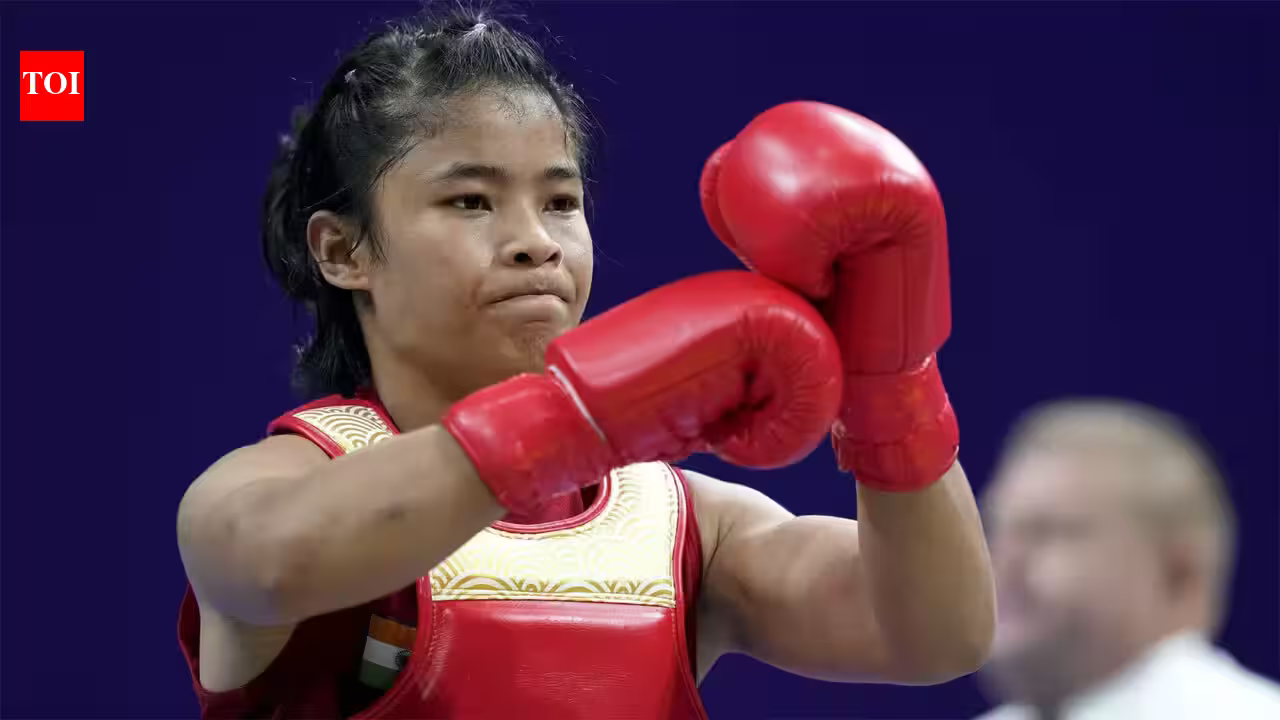
NAOREM ROSHIBINA DEVI has firmly etched her name into the history books as one of India’s most resilient and consistent martial artists. On Tuesday, the Manipuri wushu star added yet another illustrious chapter to her continental record, storming into the semifinals at the Aichi-Nagoya Asian Games and, in doing so, guaranteeing herself a third successive Asian Games medal.
Competing in the women’s Sanda 60kg category at the Aichi Prefectural Martial Arts Hall, Roshibina showcased clinical precision and tactical superiority. She dismantled Macao’s Chu Man Sin with a commanding 5-0 victory, a performance that not only punched her ticket to the final four but silenced any lingering doubts regarding her form. This latest achievement extends a spectacular streak that began with a bronze at the 2018 Jakarta Asian Games, followed by a hard-fought silver at the 2023 Hangzhou Games.
Who is Roshibina Devi?
Born on December 30, 2000, in the Bishnupur district of Manipur, Roshibina hails from the heartland of Indian combat sports. She competes in Sanda, a complex discipline of wushu that blends devastating striking techniques with intricate throws and takedowns. Since her breakout performance in 2018, she has evolved from a promising talent into the backbone of the Indian wushu contingent.
Her trajectory has been marked by steady improvement. After her bronze in Jakarta, she leveled up in Hangzhou, reaching the final and earning a silver medal after a gritty bout against China’s Wu Xiaowei. The 2023 season proved to be her most decorated yet; beyond her Asian Games silver, she claimed gold at the Moscow Wushu Stars, leading to her being conferred with the prestigious Arjuna Award and later named the International Wushu Federation’s Female Athlete of the Year. Her current run in Aichi—which included an opening victory over Bangladesh’s Shika Khatun—cements her status as an elite global competitor.
A selection controversy before Aichi-Nagoya
While her results are undisputed, Roshibina’s road to the Aichi-Nagoya Games was mired in significant administrative turbulence. The journey began with a high-profile selection battle that threatened to derail her campaign. Initially, the Sports Ministry’s August 22 squad announcement listed Divyanshi Choudhary for the women’s 60kg Sanda spot. However, a sudden injury report from the Wushu Association of India (WAI) triggered a rapid transition, leading to Roshibina’s late inclusion.
The situation spiraled into a public controversy when Divyanshi Choudhary vehemently challenged her removal. In a series of social media videos, the Kota-based athlete alleged that she was suffering from both physical and mental harassment, claiming that her medical reports were manipulated to facilitate Roshibina’s entry into the squad. Divyanshi, who trained at NIS Patiala, maintained that she had beaten Roshibina in trials and that medical professionals had cleared her to compete despite a knee injury.
What did the Wushu Association say?
The Wushu Association of India (WAI) faced intense scrutiny but remained firm in its defense of the selection process, categorizing it strictly as a medical necessity. According to the federation, Divyanshi had sustained a partial high-grade ACL tear with large effusion during a competition in Hubei, China, earlier in the summer.
The WAI stated that after her condition deteriorated at the national camp in Patiala, MRI scans at Manipal Hospital confirmed the severity of the injury. The federation asserted that the recommendation to replace her came directly from Sports Authority of India medical personnel and independent orthopedic specialists, who advised immediate rest and surgery rather than competition.
While the allegations of interpersonal harassment raised by Divyanshi have not been independently verified, the controversy eventually subsided as the athlete publicly acknowledged that her recovery took precedence, expressing her intent to focus on the 2030 Games. With the medical paperwork verified, the Sports Ministry officially greenlit Roshibina’s role as the injury replacement, setting the stage for her current medal run.
The path forward
Ultimately, Roshibina has chosen to let her performance in the arena define her narrative. By securing her spot in the semifinals, she has effectively neutralized the off-mat noise with sheer technical excellence. She now stands on the brink of another historic opportunity; a victory in Wednesday’s semifinal would elevate her to the gold-medal bout, offering a chance to finally turn her collection of bronze and silver into a coveted Asian Games gold.
As she prepares for her next opponent, the rest of the continent is witnessing an athlete who has proven that focus and consistency are the ultimate antidotes to adversity. Whether or not she secures the gold, Naorem Roshibina Devi has already secured her legacy as one of the most formidable competitors to ever represent India on the international wushu stage.
Disclaimer: This content is auto-generated for informational purposes only.
Source: Read Original News