







Homeless but Not Broken: Ukrainian Badminton Stars Carry Nation’s Flag Amidst War and Displacement
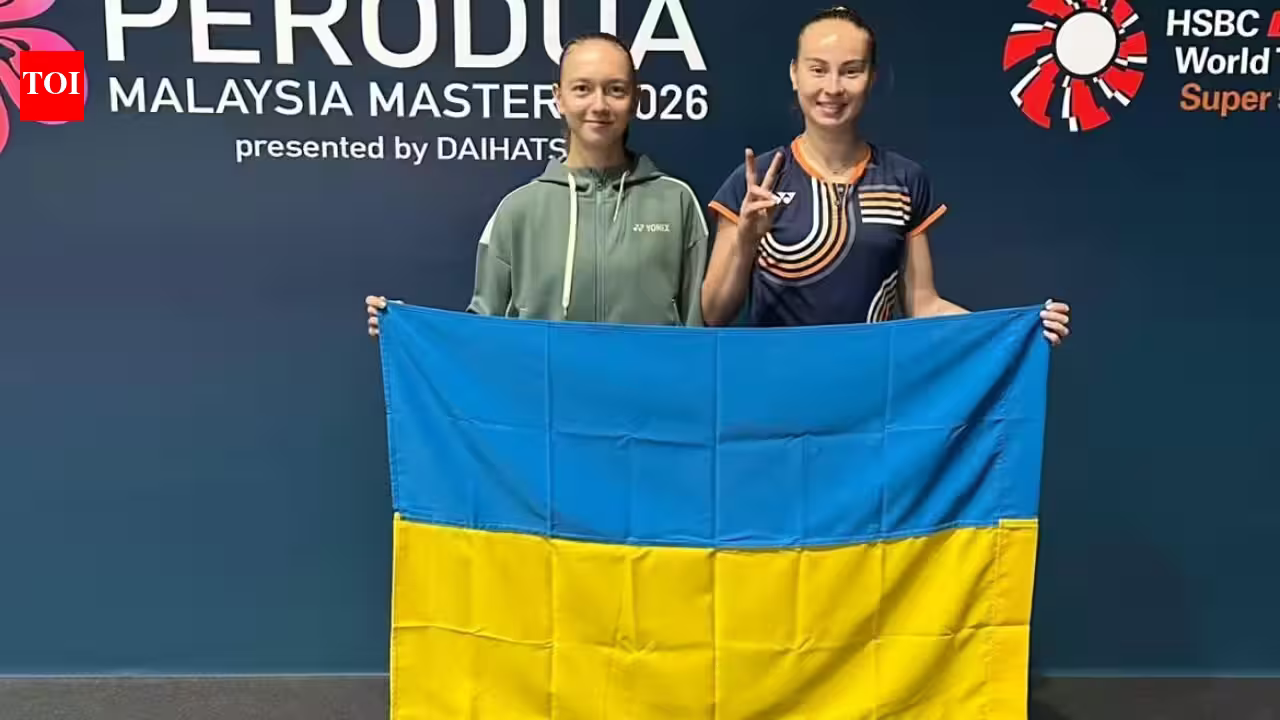
NEW DELHI – The roar of war has silenced many dreams, but for Ukrainian badminton stars Yevheniia Kantemyr and Polina Buhrova, it has only amplified their resolve. Displaced from their homes, separated from families, and training across continents, these athletes are not just competing; they are embodying the unbreakable spirit of Ukraine on the global stage, even as they face the difficult reality of sharing courts with neutral Russian athletes.
Yevheniia Kantemyr was a 16-year-old with a knee injury when her hometown of Kharkiv, a city of 1.42 million, came under Russian bombardment. The escalating conflict forced her and her family to flee. Today, her mother and brother reside 1,400 kilometres away in Slovakia, while Kantemyr, driven by her badminton ambitions, found refuge and training opportunities first in France and now in Italy.
Her women’s doubles partner, Polina Buhrova, shares a strikingly similar and equally harrowing story. The war began in 2022 while Buhrova was competing at the national championships. In the immediate aftermath, as the country reeled from relentless attacks, she and her fellow athletes endured training sessions punctuated by air raid sirens, forcing them to repeatedly seek shelter.
"The situation in Kyiv, in the capital, is terrible and my home is safe, but it’s a very bad situation now, and it’s not getting better after four years already," Kantemyr stated with palpable sadness after her first-round win at the BWF World Championships in New Delhi. "So it’s very sad and frustrating."
Also hailing from Kharkiv, the 22-year-old Buhrova has been a nomad since the war’s onset, establishing temporary training bases across Thailand, Malaysia, Denmark, and now Italy. The four years since Russia’s full-scale invasion have seen talks frozen and frontline fighting stalled, leading to an escalation in long-range attacks and devastating civilian casualties on both sides.
Buhrova vividly recalls the initial days of the invasion. "At the start of the war," she revealed, "we had our bags packed to run if the situation worsened." Tragically, bombs fell on the building adjacent to hers. With the swift assistance of her former coach, she narrowly escaped with her life. The "terrible feeling" of that experience lingers, and she hopes "nobody lives through it."
Despite the profound personal toll, Buhrova, a two-time Ukrainian national champion, now wears her country’s flag as a badge of honour that transcends personal ambition. "It’s really hard for me, but that also gives me a lot of power, and I’m really proud to represent my country as a fighter and to show how Ukraine is fighting, believing and growing," she declared after her three-set victory in her opening women’s singles match.
Neither athlete initially envisioned a career in badminton. Kantemyr was a synchronised swimmer, while Buhrova was a multifaceted artist – a pianist, dancer, and singer. Ironically, it was her piano teacher who urged her to take up a sport to improve her stage presence. "I was a fat baby," Buhrova recollected with a laugh, "and my piano teacher said I don’t look so nice on the stage… So they sent me to any sport we had in the school, and it was badminton. That’s why I started badminton, and then somehow I ended up fully in badminton, not in music anymore."
A Strong Stance on Russian Athletes
Even as they focus on their athletic pursuits, the war’s ramifications are never far from their minds. Kantemyr has not returned home since the conflict began, seeing her family only twice a year. Buhrova relies on internet calls to connect with her mother and cousins, a challenging task given the patchy connections.
The duo also shares a locker room with neutral Russian athletes, including men’s doubles team Rodion Alimov and Maksim Ogloblin, who have also qualified for the BWF World Championships. In recent months, some sports federations and the International Olympic Committee (IOC) have begun easing restrictions on Russian athletes, a decision that deeply troubles both Ukrainian players.
"Don’t allow Russian athletes to play. That was a big mistake, to allow them to participate," Kantemyr asserted firmly. "You don’t know what those athletes have done, because some of them were posting things on social media too. It’s not nice."
Buhrova echoed her partner’s sentiment with equal conviction. "I would give everything in my heart (when facing Russia). But I really wish that it would not happen, because I think it’s unfair that Russian athletes are playing, even without the flag or whatever. I think they should stay in their beautiful home, and just say thank thank you to their great government and all the people there," she stated defiantly.
For Kantemyr and Buhrova, every shuttlecock hit, every match played, is a testament to resilience and a powerful message to the world: Ukraine, though battered, remains unbroken, its spirit flying high on the badminton courts of the world.