







The release of the Surface Laptop Ultra marks a departure for Microsoft, signaling a transition toward hardware that prioritizes raw, high-end compute performance over the thin-and-light philosophy that previously defined the Surface line. With a starting price of $2,599, this machine is positioned firmly at the top of the market. It is a premium workstation designed for professionals who require significant graphical and processing power in a portable chassis.
The most notable aspect of this device is the collaboration between Microsoft and Nvidia to integrate the custom RTX Spark N1X chipset. By leveraging Nvidia’s Blackwell architecture, this laptop aims to bridge the gap between traditional enterprise notebooks and dedicated gaming or machine learning stations.
The Performance Paradigm
At the heart of the Surface Laptop Ultra lies the RTX Spark N1X processor. In the base configuration, users receive an 18-core CPU paired with a 5120-core GPU. The model tested for this assessment features an upgraded 20-core CPU and a 6144-core GPU, clocked at 4.00 GHz. This hardware is intended to handle intensive workflows, ranging from 3D rendering to local execution of artificial intelligence models.
Memory management remains a critical point of discussion for the platform. The device utilizes LPDDR5x unified memory. While the entry-level model starts at 24GB, the system architecture suggests that professional users will gravitate toward the 64GB configuration. Given that Windows 11 allocates a portion of unified memory to the GPU for graphical tasks, the 64GB model provides necessary headroom for demanding applications. Whether the 24GB base model will suffice for future software iterations remains uncertain, as the industry continues to push toward more memory-intensive local computation.
Engineering and Serviceability
Microsoft has taken a pragmatic approach to the internal layout of the Surface Laptop Ultra. Upon opening the chassis, one finds an organized interior that prioritizes cooling efficiency and component accessibility. The company has explicitly marketed the device as being built with serviceability in mind, a welcome change from previous iterations where the internal components were often heavily integrated or permanently bonded to the motherboard.
The weight and dimensions reflect the necessity of robust cooling for the RTX Spark hardware. At 4.41 pounds, the laptop is substantial, balancing its metallic build with the thermal requirements of the high-performance chipset. Connectivity is generous, featuring dual USB-C/USB4 ports, a dedicated USB-C port with magnetic charging, a legacy USB-A 3.1 port, and an HDMI 2.1b connection. The inclusion of an SD card reader further reinforces its utility for creative professionals who need to ingest media from professional cameras without the need for additional dongles.
A High-Fidelity Visual Experience
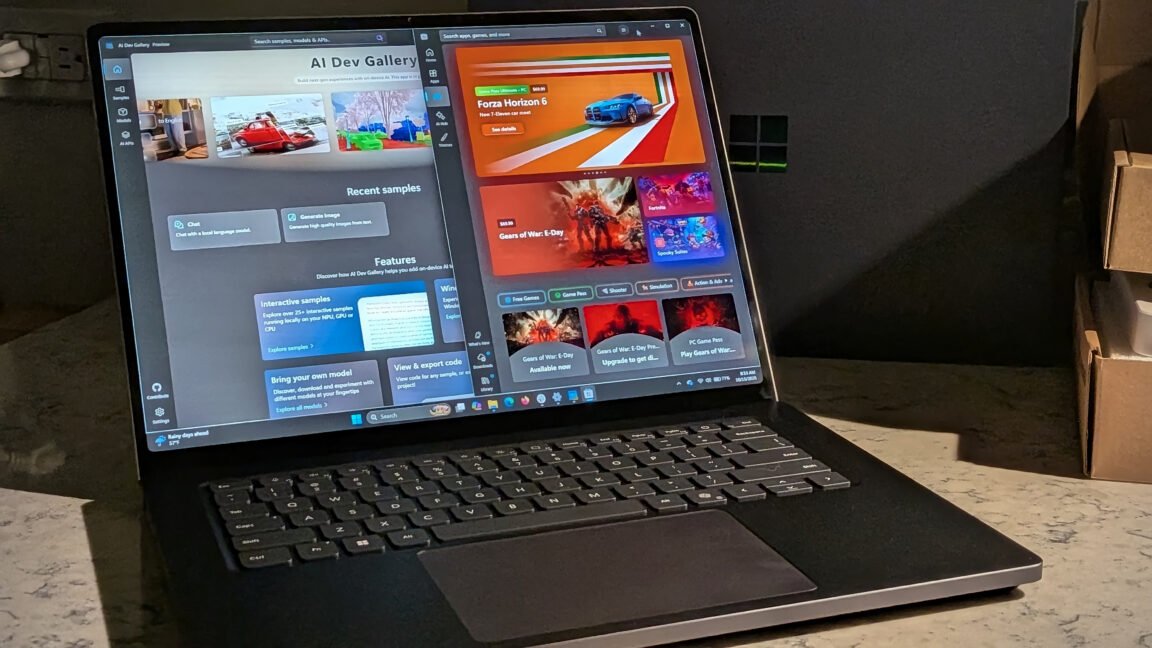
The display is a standout feature of the hardware. The 15-inch mini-LED touchscreen offers a 3:2 aspect ratio with a native resolution of 3270×2180. This results in a pixel density of 262 PPI, which provides sharp, detailed text and image rendering. With a dynamic refresh rate that scales up to 120 Hz, movement across the desktop environment feels fluid and responsive.
Color accuracy is another highlight. The device ships with several color profiles, including Vivid, sRGB, and an Enhanced mode, which are calibrated to provide deep, accurate color reproduction. The mini-LED technology allows for precise local dimming, ensuring that blacks remain deep even when juxtaposed against high-brightness elements. With a peak brightness of 2,000 nits, the display remains highly legible in daylight. However, users should be aware that the glossy glass coating can lead to reflections in high-glare environments. While the display performance is excellent, those who prefer a matte finish may need to use a screen protector, as the native panel is highly reflective.
Software and Hardware Alignment
The software experience is split based on the chosen hardware configuration. The base 24GB model runs Windows 11 Home, while higher-tier versions move to Windows 11 Pro. This segmentation indicates that Microsoft intends the 24GB variant for general professional use, while the 64GB configuration targets developers and power users who require the advanced management and virtualization features found in the Pro edition.
The challenge facing the Surface Laptop Ultra is the traditional lag between hardware innovation and software optimization. While the Blackwell RTX GPU provides the necessary foundation for high-end tasks, the ecosystem is still adapting to the specific architectural benefits of the Spark N1X chip. Microsoft’s focus on “local models” suggests that the company envisions this machine as a primary device for executing AI workloads, though it may be several months before third-party software updates fully utilize the capabilities of the hardware.
Final Market Positioning
The Surface Laptop Ultra is a clear move to capture the professional segment of the market that previously felt underserved by mobile silicon limitations. By opting for a high-performance Windows-Nvidia partnership, Microsoft has created a device that is not meant to compete with entry-level ultrabooks, but rather to function as a powerful desktop replacement.
Prospective buyers must weigh the premium price point—which reaches up to $5,899 for top-tier specifications—against the specific requirements of their workflows. For those who require consistent, high-performance computing, the 64GB model appears to be the most balanced solution. While the laptop excels in display quality, build integrity, and raw horsepower, its ultimate success will depend on whether developers leverage the specialized hardware sufficiently to warrant the significant investment. The hardware is undeniably bleeding-edge, and it serves as a powerful statement for the future of the Surface brand.
Disclaimer: This content is auto-generated for informational purposes only.
Source: Read Original News