







NVIDIA Unveils DLSS 5: RTX 50 Series Leapfrogs Performance Expectations
NVIDIA has officially pulled back the curtain on its next-generation upscaling and image generation technology, DLSS 5. Designed exclusively to leverage the immense power of the new Blackwell-based RTX 50 series GPUs, this latest iteration promises a revolutionary shift in how games are rendered, effectively moving from traditional reconstruction to generative neural rendering.
Performance Breakdown: A New Era for High-Refresh Gaming
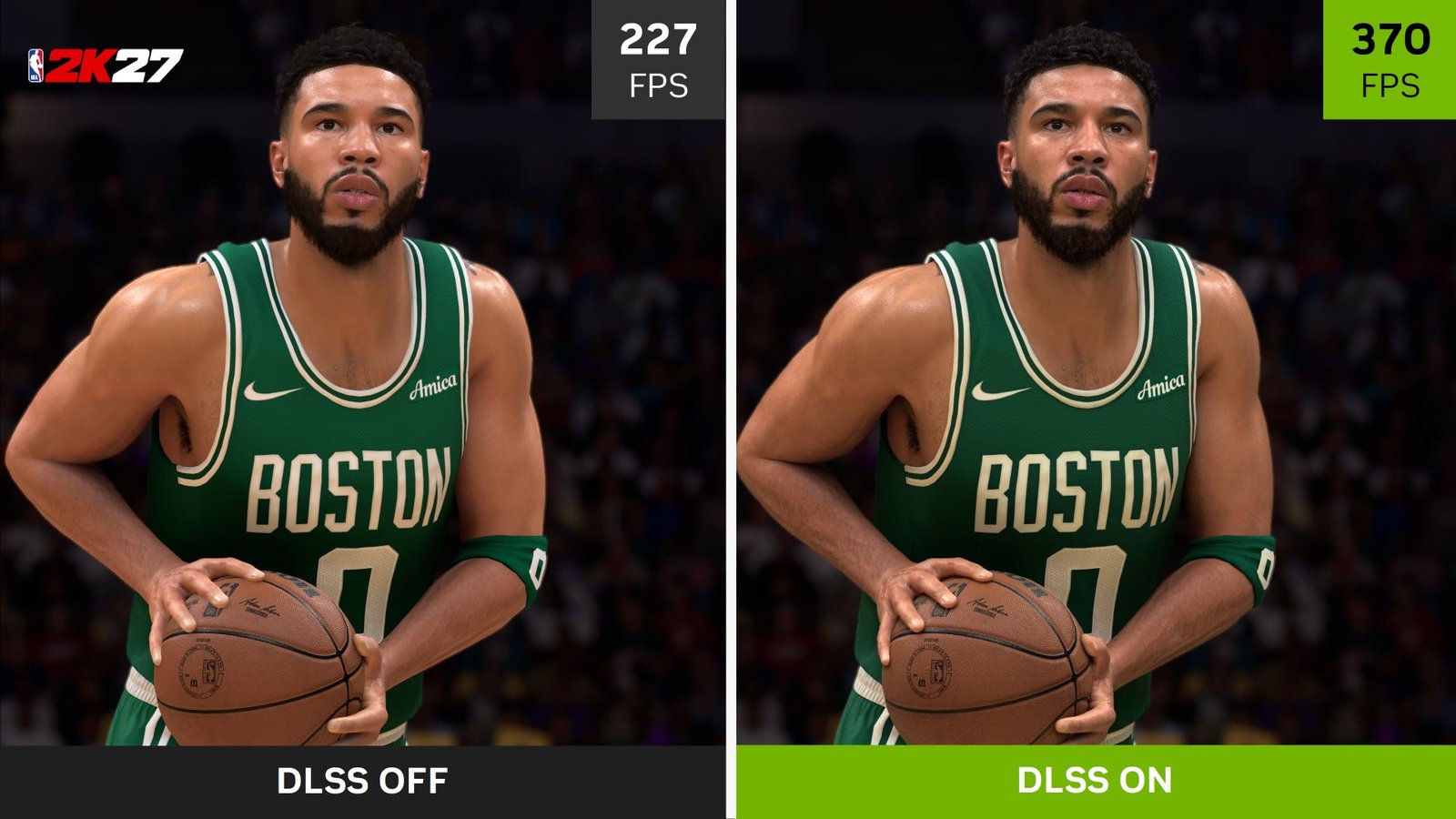
The first title to feature native support for this technology is NBA 2K27. NVIDIA’s performance figures demonstrate that the RTX 50 series is capable of delivering unprecedented frame rates when utilizing DLSS 5 alongside Ray Tracing at Ultra settings.
Across various resolutions, the performance gains are staggering:
- 1080p: Even the entry-level RTX 5060 surpassed 250 FPS, while the high-end cards reached heights of 500+ FPS.
- 1440p: The RTX 5070 maintained over 260 FPS, with the flagship RTX 5090 soaring past the 500 FPS mark.
- 2160p (4K): At native 4K, the RTX 5080 delivered an average of 233 FPS, while the RTX 5090 crushed the benchmark with an average of 370 FPS.
The Shift from Reconstruction to Generation
NVIDIA emphasizes that DLSS 5 is fundamentally different from its predecessors. While versions 1.0 through 4.5 focused on “reconstruction”—using sparse inputs to match a fixed ground truth—DLSS 5 operates as a generative model.
“DLSS 5 does not have a ground truth,” a spokesperson explained during the presentation. “The artist’s direction is the new ground truth.” By providing developers with a toolkit to manipulate the rendering pipeline, NVIDIA is empowering creators to bypass traditional compute and VRAM limitations, allowing them to fulfill their specific artistic vision through AI-driven neural rendering.
Developer-Centric Controls
A point of clarity provided by NVIDIA concerns the “modding” community versus official implementation. While internet users have been experimenting with unofficial parameters to alter visuals, native DLSS 5 support is built as a developer toolset. In official implementations, the technology will appear as a simple “On/Off” toggle for the end-user, ensuring that players experience the game exactly as the developers intended.
However, the ease of integration—thanks to NVIDIA’s Streamline framework—means that developers have significant freedom. They can choose to apply different levels of DLSS 5 to specific assets, such as foliage or characters, without incurring performance penalties, as the model’s resource cost does not scale based on the complexity of the screen-space buffer.
Rapid Optimization
The speed of progress for this technology has been remarkable. Since its initial debut at GTC in March 2026, which required dual RTX 5090 GPUs to run, NVIDIA has achieved a 5x performance improvement in just six months. This was achieved through a combination of hardware-software co-design, refined kernels, and architectural optimizations that now allow the model to run efficiently on a single RTX 50-series card.
Looking Ahead
While official support is currently limited to the RTX 50 series due to the complexity of the model and the specific requirements of the latest Tensor cores, the implications for the future of PC gaming are profound. As developers continue to adopt these tools, and as NVIDIA prepares further optimizations for later this year, the gaming industry is poised to move closer to a standard of “unlimited” visual fidelity at high frame rates.
NBA 2K27 officially launches with DLSS 5 support on September 3rd at 9 PM PT.