








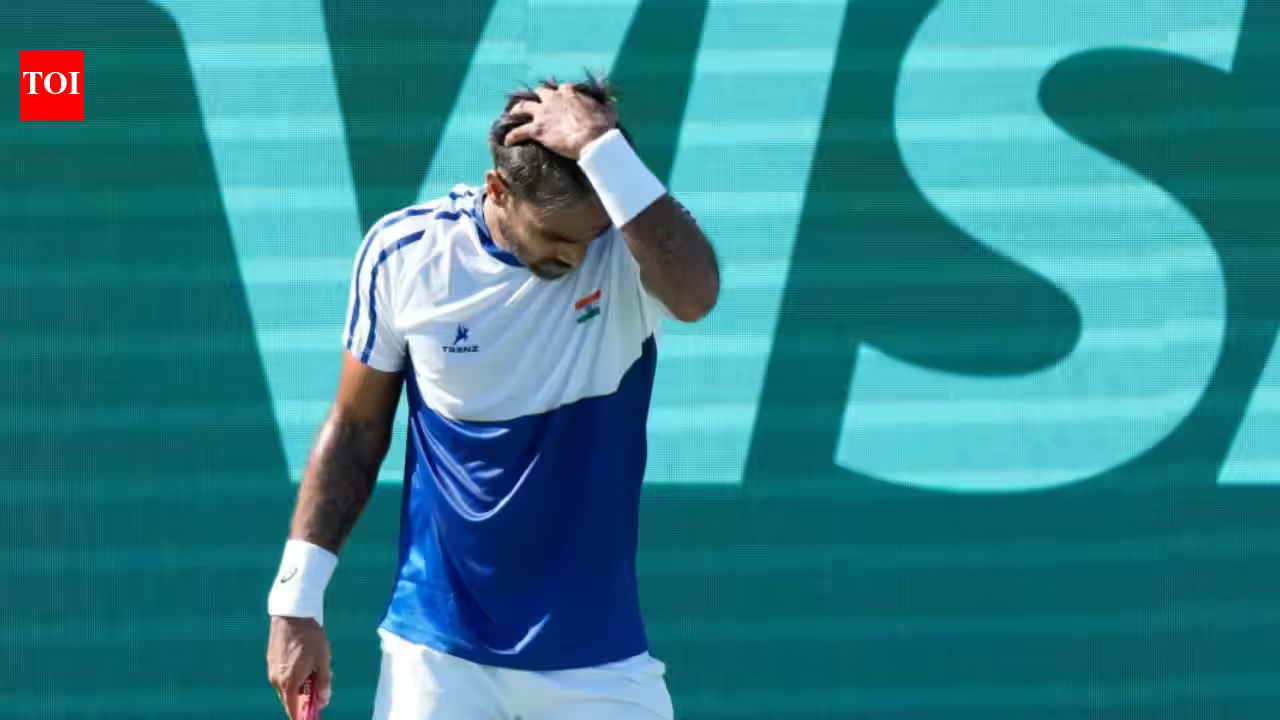
Tensions flared in the coastal town of Maia, Portugal, this week, but it was not just the high-stakes tennis on display that caught the attention of the international sporting community. Indian tennis icon and national No. 1, Sumit Nagal, found himself at the center of a post-match controversy following a grueling first-round victory at the Maia ATP Challenger, forcing the veteran campaigner to issue a public apology for a lapse in judgment.
The incident occurred in the immediate aftermath of a marathon three-set thriller. Nagal, currently spearheading India’s charge on the international circuit, outlasted home favorite Henrique Rocha in a contest that spanned two hours and 56 minutes. The final scoreline—6-3, 5-7, 7-6(5)—barely captures the intensity of a match where Rocha, buoyed by a passionate local crowd and recent form, pushed the Indian to the absolute brink. Having claimed a title in Porto just eight days prior, Rocha was playing with supreme confidence, serving for the match on two separate occasions before Nagal’s trademark resilience allowed him to claw back and clinch the victory in a tense third-set tie-break.
## A “Heat-of-the-Moment” Lapse
In the high-pressure environment of professional tennis, emotions often spill over. Upon shaking hands at the net, Nagal directed a “talking gesture” toward the crowd—a move that was quickly perceived as disrespectful by the local Portuguese spectators who had been vociferously backing their countryman.
Recognizing the gravity of his actions almost immediately, Nagal took to social media to express his remorse, opting for transparency and direct accountability. “To the crowd in Maia, I want to apologise for the talking gesture I made after the match. It was a heat-of-the-moment reaction, and it wasn’t the right way to respond,” Nagal wrote in an Instagram post.
Beyond the public apology, Nagal took the professional route by addressing the source of the friction directly. He confirmed that he had reached out to his opponent, Henrique Rocha, to offer a personal apology for the behavior. “I respect everyone who came out to watch, and I appreciate you being there. I’ve also spoken to Henrique and apologised to him personally,” the statement read.
For Nagal, the incident serves as a stark reminder of the unique pressures faced by professional athletes who must balance the raw, competitive fire required to win with the diplomatic expectations of the global tour.
## Reflecting on a Challenging Season
The incident in Portugal comes at a point of reflection for both Nagal and the broader landscape of Indian tennis. The current season has been a taxing one for the nation’s top players, underscored by the disappointment at the recent Asian Games.
Nagal, who entered the continental games as India’s primary hope for a singles podium finish, faced a bitter exit in the men’s singles quarterfinals. His straight-sets loss to China’s Yibing Wu—4-6, 4-6—effectively signaled the end of India’s medal aspirations in the tournament. The result was particularly jarring, as it marked the first time since 1986 that an Indian contingent has returned from the Asian Games empty-handed in tennis, breaking a historic streak of podium finishes that had been sustained since 1990.
The failure of the doubles combinations to progress beyond the quarterfinal stages further compounded the sense of underachievement, leaving fans and analysts to scrutinize the current developmental pipeline. The campaign in China has ignited a national conversation regarding the depth of Indian tennis talent and the strategies required to remain competitive on the world stage.
## Looking Ahead: The Path Forward
Despite the disappointment of the Asian Games and the recent lapse in Portugal, Nagal remains the standard-bearer for Indian tennis. His ability to compete at the Challenger level and navigate intense, three-hour battles against rising prospects like Rocha demonstrates that he still possesses the technical and physical tools to contend with the best.
The apology issued by the Indian star reflects a maturity that will be necessary as he navigates the remainder of the European indoor swing. Tennis is a sport of cycles, and while India currently faces a dip in its historical performance at major multi-sport events, the commitment shown by individuals like Nagal to rectify their mistakes both on and off the court is a vital step toward long-term stability.
For now, the focus shifts back to the baseline. As the dust settles in Maia, the hope for Indian tennis fans is that Nagal can channel his competitive energy into his next match, turning the page on this controversy and continuing his pursuit of the ranking points necessary to keep India relevant in the global rankings. The path back to the winner’s circle is never easy, but in the unforgiving world of professional tennis, the ability to bounce back from defeat—and from one’s own mistakes—is the true hallmark of a top-tier athlete.
Disclaimer: This content is auto-generated for informational purposes only.
Source: Read Original News