







Apple has officially updated its power adapter lineup, marking a significant shift in the hardware connectivity standard for its charging ecosystem. The company has transitioned from its long-standing power connector design to a new specification, dubbed AC Connector 2, across its 70W and 140W power adapters, as well as its dedicated power adapter extension cable. This rollout coincides with the return of the World Travel Adapter Kit to Apple’s official storefront, ensuring that users have access to a full suite of compatible international plugs that utilize the updated connection interface.
The Shift to AC Connector 2
The primary difference between the legacy hardware and the new components lies in the physical geometry of the connection point. Apple’s previous standard, now referred to as AC Connector 1, featured a distinct notched design where the interchangeable plug met the body of the power adapter. The new AC Connector 2 adopts a refined, pill-shaped interface. According to documentation released by Apple, this design change is not merely aesthetic but serves to satisfy updated international electrical and safety regulations.
By standardizing this pill-shaped design, Apple ensures that its power delivery hardware adheres to modern safety mandates. While the change appears minor at a glance, it represents a fundamental break in mechanical compatibility. Plugs designed for the older, notched interface cannot be attached to power adapters requiring the new pill-shaped connection, and vice-versa. This distinction is vital for consumers to understand before purchasing replacement parts or supplemental accessories.
Compatibility and Resolving Consumer Frustration
Earlier this year, Apple began introducing the AC Connector 2 in specific international markets. This silent transition initially caused confusion and friction for many users. Customers who purchased newer MacBook Pro models equipped with the latest adapters found that their existing legacy extension cables or older international travel plugs did not fit the new hardware. The lack of backward compatibility resulted in reports of frustration as users found themselves unable to use their established charging accessories with the updated adapters.
With the latest release, Apple has effectively addressed these compatibility concerns. By updating the 70W and 140W adapters and simultaneously releasing a revised version of the World Travel Adapter Kit, the company has synchronized the entire ecosystem. Users who acquire any of these current-generation products can now rely on full compatibility within the AC Connector 2 standard, ensuring that travel adapters and extension cables fit perfectly with their specific power bricks.
Restoration of the World Travel Adapter Kit
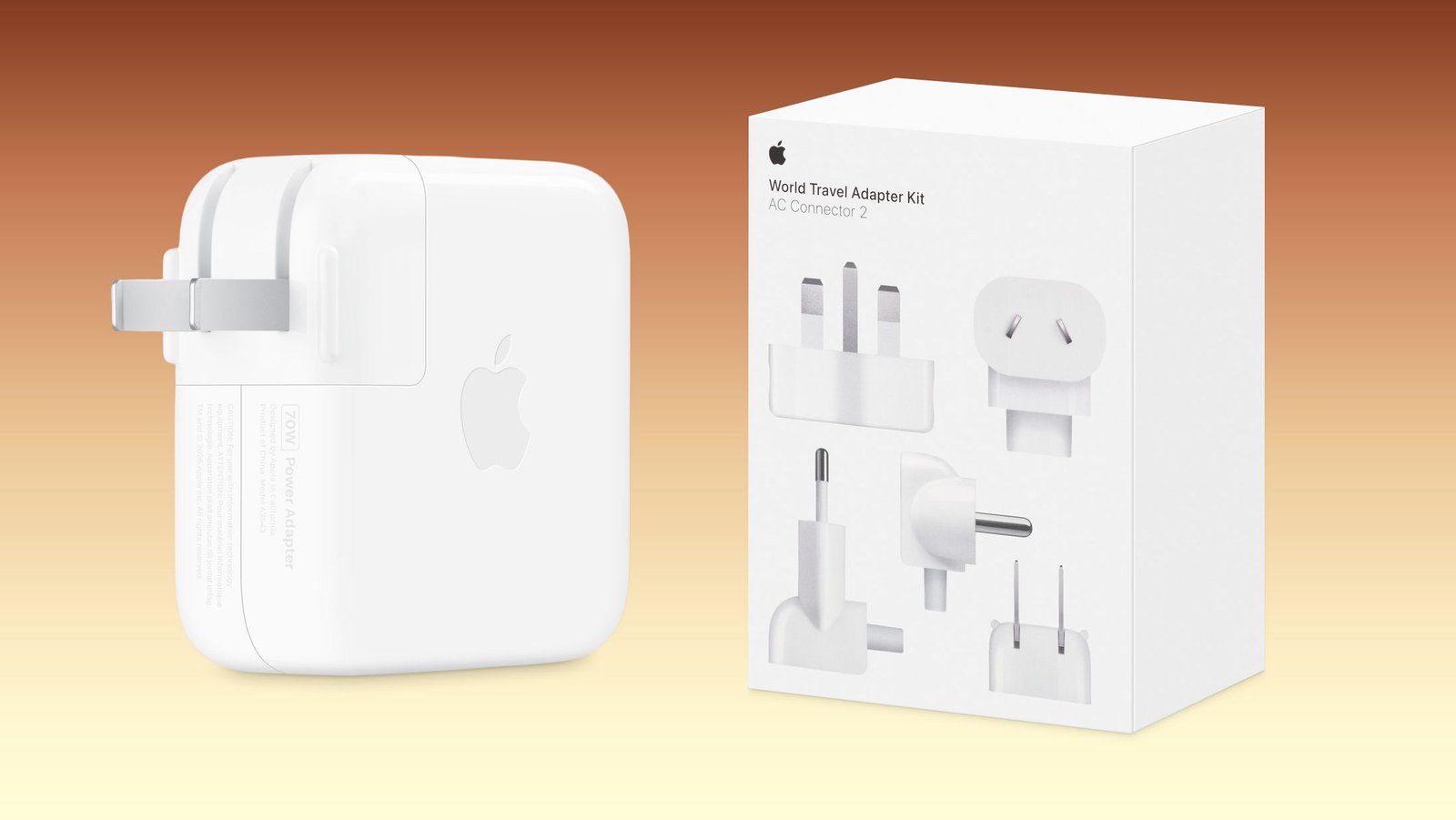
A notable inclusion in this release is the reintroduction of the World Travel Adapter Kit, which had been removed from the online store catalog in 2025. Priced at $39, the kit serves as a comprehensive utility for international travelers. It includes five interchangeable AC plugs, covering a vast range of global electrical standards, including Type A (North America/Japan), Type C (Europe/Brazil), Type D (India), Type G (UK/Middle East/Singapore), and Type I (Australia/New Zealand).
Each of the plugs included in this refreshed kit has been manufactured to interface with the AC Connector 2 standard. For frequent travelers who rely on the modular nature of Apple’s chargers to maintain power for multiple devices, the availability of this kit is a significant restoration of utility. It effectively bridges the gap between Apple’s proprietary power hardware and the diverse wall outlet configurations encountered across the globe.
Technical Implications and Use Cases
The 70W and 140W adapters remain central to the high-performance computing experience offered by Apple. The 70W model is designed for mid-range portables, providing a balance between portability and rapid charging capability, while the 140W adapter is intended for high-end workstations that require substantial power delivery to maintain peak performance under heavy load. By incorporating the AC Connector 2 into these specific units, Apple ensures that the power-hungry internals of its latest laptops can be safely connected to power sources worldwide.
The extension cable, often favored by users whose wall outlets are situated in difficult-to-reach locations, has also been modernized. For professionals who require a longer reach from a power source—such as in conference rooms or airport terminals—this updated cable provides a seamless connection to the power adapter, maintaining the necessary wattage throughput while complying with the latest physical safety specifications.
Impact on Future Hardware Ecosystems
This update indicates a broader trend toward internal hardware standardization for compliance. As global regulations regarding electrical safety and hardware durability continue to evolve, tech manufacturers are increasingly tasked with redesigning legacy interfaces. Apple’s move to clearly differentiate between AC Connector 1 and AC Connector 2 provides a template for managing such transitions.
For the average user, the takeaway is the necessity of verifying the connector type when sourcing third-party or replacement accessories. As the hardware market moves away from the older notched design, users should look for the pill-shaped interface markings to ensure their power adapters are future-proofed for the current generation of charging hardware. By simplifying the lineup to one primary connector type moving forward, Apple has effectively minimized potential for hardware mismatches, provided that consumers are aware of the transition between the two distinct generations of plugs.
Disclaimer: This content is auto-generated for informational purposes only.
Source: Read Original News